 Ahmed Elflal
Every month someone sits across from me with the same story.
They spent real money on ads in Dubai or Riyadh. The leads came in. Most were junk. The sales team stopped answering them. And now the whole company quietly believes lead generation does not work in this region.
It works. I have built it for B2B companies across the Gulf for years, and it is the only thing I build. But it only works as a system, and almost nobody builds the system. They build fragments: an ad here, a landing page there, a follow-up process that lives in someone's head.
This guide is the whole thing, end to end. What breaks, what the system looks like, which channels actually work here, and the honest numbers you should expect. Every section links to a deeper playbook if you want the full mechanics.
Why most B2B lead generation in the GCC fails
Two reasons, and neither is the ad platform.
The first is build order. Most companies start with the ad, because the ad is the visible part. Someone picks an audience, writes a headline, boosts a post. But the ad is the last thing that should be built, not the first. Underneath a failing campaign there is almost always a weak offer nobody feels urgency to claim, and no qualification, so every click becomes a "lead", including the students and the browsers. The sales team drowns, then gives up.
The second is imported playbooks. Most of the advice you will read was written for the US or Europe, and it quietly assumes things that are not true here. It assumes a Monday to Friday week, when the Gulf runs Sunday to Thursday. It assumes email is where follow-up happens, when here a phone number is a WhatsApp number and email is where messages go to be ignored. It assumes one decision-maker, when a UAE or Saudi deal often runs through a buying committee: a general manager, a family owner, a finance gatekeeper, sometimes all three. And it assumes English, when the market lives in both Arabic and English and your language choice is itself a trust signal.
Run a foreign playbook here without adjusting for any of that, and it does not fail loudly. It just leaks money until someone concludes the region is the problem.
The region is not the problem. The build is. So let me show you the build.
The system: four layers, one buyer
Everything I run sits on the same architecture, which I call the 4-layer system: Offer, then Copy, then Media, then Funnel, built in that exact order, all on one deeply understood buyer. I wrote up the 4-layer system as its own piece; here is how each layer works and why the order is the point.
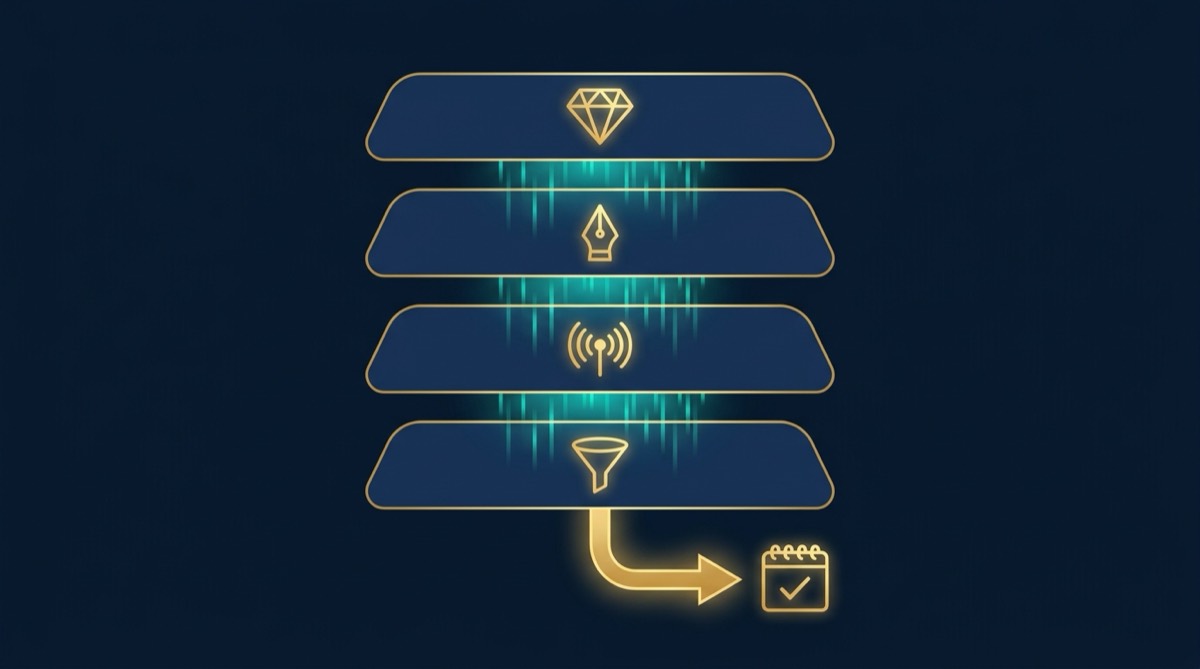
Before the layers, the foundation. I map every buyer with FRED: Fears, Results, Expectations, Desires. Every layer above is built for one real person, not a demographic guess. Get this wrong and all four layers inherit the mistake.
Layer 1: the Offer
The offer does roughly 60% of the selling before an ad ever runs. A brilliant ad for a boring offer still fails. A plain ad for an irresistible offer still works.
The logic behind a strong offer is the old value equation: the dream outcome and the odds of hitting it, weighed against the time it takes and the effort involved. Push the first two up, pull the last two down, and the offer strengthens on its own, without clever words propping it up. I run every offer through five levers I call the 5Ts before I write a single line of copy. The full process is in how I engineer offers.
In the Gulf this layer matters even more than elsewhere, because trust is the expensive part here. Buyers have been burned by big promises. An offer that lowers their risk of saying yes beats one that just shouts a bigger claim.
Layer 2: the Copy
Copy is how the offer travels. Its job is not to be clever; it is to make the right person stop, feel understood, and want what the offer gives them.
I write around the Triple Hook: hook the attention with a first line that names the buyer's pain in their own words, hook the interest by showing I understand the problem better than they expected, then hook the desire by pointing it all at the offer with a small, specific next step. Then I match the message to audience temperature: fear and problem for cold audiences, proof for warm, desire and offer for hot. The full breakdown lives in how I write ads that convert.
One GCC note: do not just translate winning English copy into Arabic. Arabic copy needs to be written, not converted, because the pain points are voiced differently. A literal translation reads like a foreign ad wearing a costume, and buyers can smell it.
Layer 3: the Media
Now the offer and copy have somewhere to go. And here, simpler wins.
I run one consolidated campaign with budget optimisation at the campaign level, broad targeting, and the budget pooled so the platform has room to learn. Then I feed it 10 to 20 varied creatives, different hooks, angles, and formats, and let delivery find the winners.
This is deliberate. Meta's Andromeda update moved delivery from audience-based to creative-based, which means the machine reads the creative to decide who sees it. Your targeting now lives inside the ad itself. So I stopped hand-picking narrow audiences and started feeding the system a rich spread of creative instead. That single shift is why the consolidated structure beats the old fifty-ad-set sprawl. Mechanics, structure, and scaling are all in the media buying playbook.
Layer 4: the Funnel
The media brings people in. The funnel decides who reaches your sales team, and this is the layer most GCC campaigns skip entirely.
I build qualification into the funnel itself, before anyone reaches a human: instant forms for volume offers, a sales-letter appointment funnel for high-ticket, and in both cases just enough questions to quietly run the four buyer checks. Then fast follow-up, because a Gulf lead that waits a day is a lead that booked with someone else on WhatsApp.
Which brings us to the checks themselves.
Qualification: BANT, and what sales-ready actually means
"Lead" is the most abused word in marketing. A form fill is not a lead. A phone number scraped from a directory is definitely not a lead.
The filter I use is BANT, four checks that decide whether someone is a real buyer. Budget: can they afford the fix. Authority: can they actually say yes, or do I need someone else in the room. Need: is there a genuine problem I solve. Timing: do they want it soon, or is this a someday problem.
A sales-ready lead is a yes on all four, checked by the funnel before your team spends a minute on them. Done well, this is what lets me hand a sales team calls where roughly 60 to 95% of the people who arrive are genuinely sales-ready, depending on the offer and how tight the filter is set. The exact questions I ask, and how to ask them without scaring off real buyers, are in the lead qualification and BANT guide.
The GCC wrinkle is Authority. In a family business or a larger Gulf firm, the person filling the form is often not the person who signs. I do not treat that as disqualification; I treat it as routing. The funnel asks who else is involved in the decision, and the sales process plans for the committee from the first call instead of discovering it on the third.
The channels that actually work in the Gulf
The system above is channel-agnostic. But channels are where the GCC gets specific, so here is my honest read on each, with the deep dive linked.
Paid social is the workhorse. Meta carries most of the volume for B2B here, which surprises people who expect LinkedIn to dominate. Decision-makers in the Gulf scroll Instagram and Facebook like everyone else, and after Andromeda the creative does the targeting. This is the media layer described above, run exactly as written.
Cold outreach wins the accounts you cannot wait for. When there is a specific list of companies you want, you go to them instead of waiting for the algorithm. But cold calling here is not the imported version: it works the Sunday to Thursday week, avoids prayer times, opens with honesty instead of a pitch, and pairs every dial with a WhatsApp message the same minute. I wrote the full cold calling playbook for the GCC, including the script I actually use.
Appointment setting turns bookings into meetings that happen. A booked call is not a held call. The confirmation and reminder system behind my funnels, which lifts show-up rates to 80 to 95%, is its own discipline, covered in the appointment setting guide.
WhatsApp is the follow-up layer under everything. If you take one channel decision from this guide, take this one. In the Gulf, WhatsApp is where business actually talks: it confirms meetings, carries reminders, answers objections, and revives leads that went quiet. I have built entire monetisation flows on it, and the WhatsApp money model shows how follow-up becomes revenue rather than admin.
Demand generation is the awareness layer. Lead generation harvests demand; demand generation creates it. Content, authority, and problem education make every other channel cheaper, because a buyer who already knows you clicks cheaper and closes faster. How that layer works, and when it is worth the patience, is in the demand generation guide. For the wider strategic picture across the region, start with B2B marketing in the GCC.
What results to expect
Let me put numbers on it, because a guide without numbers is just opinion. These are the ranges I see when the system is built properly, and they are ranges for a reason.
Cost per qualified lead in a well-built Gulf funnel tends to land around 50 to 60 dollars. Qualified is the key word: that is the cost of a lead that passed the BANT filter, not a raw click or form fill.
Return on ad spend, once the system has learned and the offer is proven, lands anywhere from 4 to 11 times. The spread is honest: a high-ticket offer with a sharp closer sits at the top, a newer offer still finding its feet sits lower.
Lead quality, with qualification baked in, runs 60 to 95% sales-ready depending on the offer and filter tightness. And show-up rates on booked calls reach 80 to 95% when the appointment system does its job.
On timing: the first leads usually arrive within a week or two, because paid media buys attention fast. But the numbers you can plan around take a few weeks to settle while delivery learns and fresh creatives rotate in. Early spikes and dips are noise, not signal.
One warning about all of these: never optimise for the cheapest lead. A 20 dollar lead that never buys costs more than a 60 dollar lead that closes. The number I actually chase is cost per closed deal, and every layer in this guide exists to pull that number down.
Hire it out, or build it in-house?
Everything above is buildable in-house. This guide, plus the linked playbooks, is genuinely the blueprint; I have hidden nothing in a black box. If you have a marketer who can engineer offers, write ads, buy media, and build qualification funnels, build it yourself and keep the skill in the company.
The honest catch is that most companies have pieces of that stack, not the whole thing. A good media buyer with no offer skills, or a strong copywriter with no funnel discipline. The system leaks exactly at the missing skill, and the leak is paid for in ad spend while the team learns.
If you would rather have it built and run for you, that is what I do, and I have written up exactly what that looks like so you can judge it before we ever speak: what a B2B lead generation agency should actually be doing for you, method shown layer by layer. If you are UAE-based, I have also broken down how this applies specifically to lead generation in Dubai, to the procurement-led way Abu Dhabi companies actually buy, and where it sits inside the wider work of a B2B marketing agency in Dubai. For the Kingdom, the same four layers are tuned differently again in how I generate B2B leads in Saudi Arabia. If you sell software rather than services, the motion changes again in lead generation for GCC SaaS companies. The step-by-step version of this system is how to do B2B lead generation, and the wider menu of tactics is in 15 strategies I would actually use in the Gulf. For the plain-English starting point, there is what B2B lead generation actually means. The nurture layer that turns those captured leads into booked calls is written up separately, in how I run email marketing for Dubai B2B companies.
Whichever way you go, do not outsource understanding your own buyer. The FRED work, the offer thinking, the knowledge of what your market fears and wants: that should live in your company even if the execution does not.
And if you want to see the whole machine assembled, with each layer in its place, the system page walks through it end to end.
Build the offer first. Write copy that filters. Keep the media simple and feed it creative. Qualify hard before anyone books. Follow up on WhatsApp within minutes, on Gulf time.
That is B2B lead generation in the GCC. Not a trick, not a hack. A machine, built in order.