 Ahmed Elflal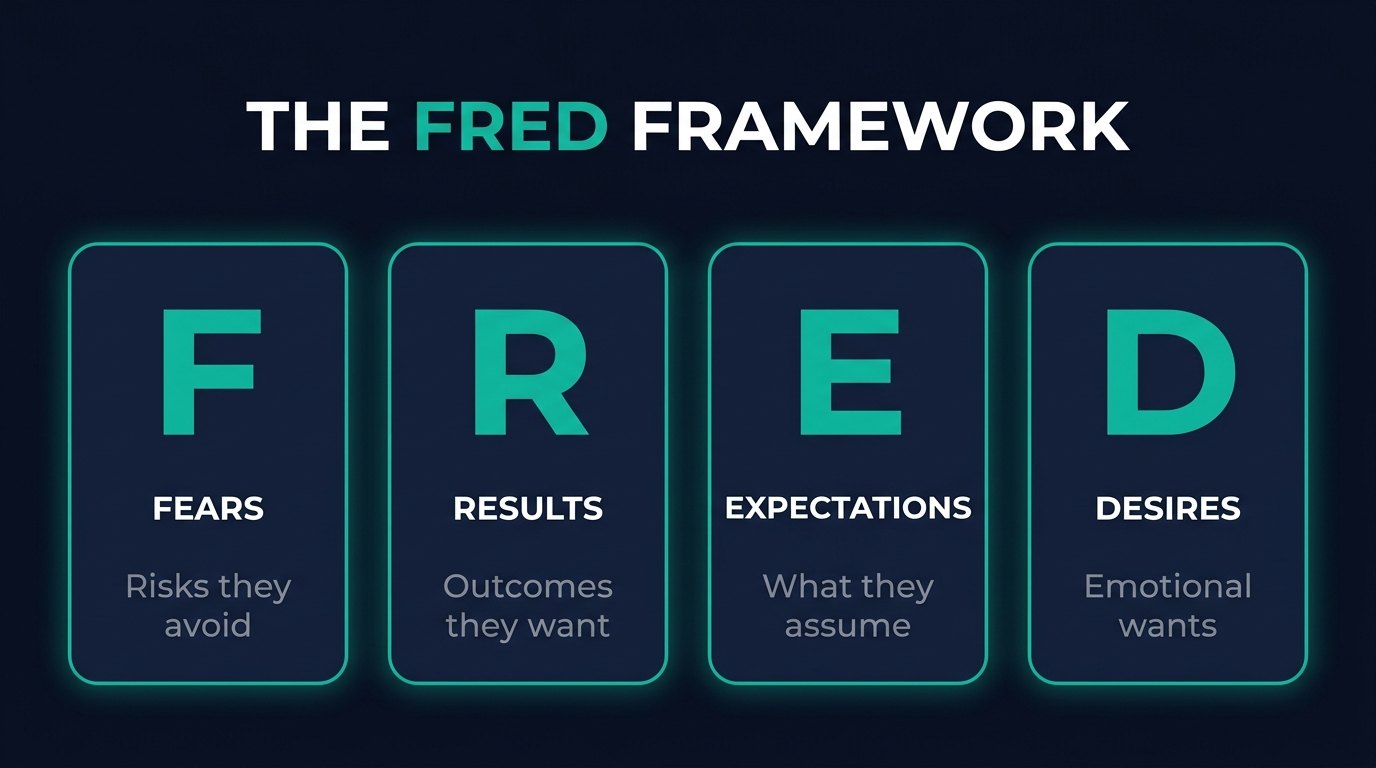
Most buyer personas are useless.
"Decision-makers, 30 to 55, UAE, mid-market" tells you what your buyer looks like on a form.
It tells you nothing about how they think, what they fear, or the words they use when they describe the problem to a colleague.
And the words are where the money is.
FRED is the framework I run on every persona before a single dollar is spent. It maps the four drivers that actually move a buyer.
F is for Fears
The risks they avoid. The hesitation, the second-guessing, the friction, practical and emotional.
What are they afraid will go wrong if they say yes? What does it make them look like if it fails?
You use Fears to remove friction and reverse risk. An unspoken fear is what kills a deal that looked won.
R is for Results
The clear, measurable outcome they actually want. Not "growth." The specific number.
Results are what you anchor your value proposition and your benefit copy to. It is the destination they are paying for.
E is for Expectations
What they assume before they ever talk to you. How long it should take. How much effort. What support. What the process looks like.
You either align with those expectations to build trust, or deliberately challenge them when they are wrong.
Either way you have to know them. A buyer measures you against the expectation in their head, not the one in your deck.
D is for Desires
The aspirations beyond logic. The emotional wants. The identity they are reaching for.
Results are rational. Desires are why the result matters to them personally.
Desires create resonance. They are the reason a buyer feels like you actually get them.
How to use each one
FRED is not a document you file.
Address the Fears to lower risk.
Anchor the offer to the Results.
Align or challenge the Expectations to build trust.
Tie the emotional hooks to the Desires.
When all four are handled, the buyer feels understood. And feeling understood is most of persuasion.
FRED is the core, not the whole picture
FRED sits inside a fuller method.
Around it I map PQR2: the Problems they face daily, the Questions they carry, the Roadblocks in their way, and the Results that signal progress.
Then the cost of inaction: what actually happens if they do nothing. The slow decline. The wasted potential.
FRED gives you the drivers. PQR2 and cost of inaction give you the pressure.
Map FRED to audience temperature
The four drivers also tell you what to say, and when.
A cold audience responds to Fears and Problems named precisely.
A warm audience needs Expectations addressed and Results proven.
A hot audience moves on Desires and the offer.
Same persona. Different driver in front, depending on how close they are to buying.
Where the real FRED comes from
You do not invent FRED at a desk.
You mine it from how the buyer actually talks. Real testimonials. Reddit and Quora threads. LinkedIn comments. Review sites. Recorded sales calls.
Pull the verbatim quotes, the repeating emotions, the exact phrases they use.
Then your copy uses their language, not yours. That is the difference between an ad written for them and one written at them.
Why this is the highest-leverage work
Every downstream asset inherits the persona.
Get FRED right and the hook, the offer, the form questions, and the follow-up all pull the same direction, because they were built from the same understanding of one real person.
Get it wrong and you are optimizing ads for someone who does not exist.
That is why FRED is the first thing I build and the last thing I cut.