 Ahmed Elflal
Let me clear something up before we start.
People keep telling me cold calling is dead.
It is not dead. It is just badly done.
What died is the old version: buy a random list, read a robotic script, dial two hundred numbers, annoy most of them, and call it a day. That never worked well, and it works even worse now.
What still works is cold outreach done with judgement, where the call is one move, not the whole game. That is what I want to walk you through, the way I actually run it for B2B companies across the Gulf.
Cold calling is one channel. Cold outreach is the play.
First, a distinction that changes everything.
Cold calling is a single channel. You phone someone who never asked to hear from you.
Cold outreach is the whole play. It is every way you reach a stranger and start a conversation: the call, yes, but also a LinkedIn message, an email, and here in the Gulf, WhatsApp.
Some people call it cold outreach, some call it prospecting, some still just say cold calling. The label matters less than the habit behind it: I never rely on one channel to carry the whole job.
A prospect who lets your call ring out will often reply to a sharp LinkedIn note. Someone who ignores your email will pick up the phone. The channels cover for each other. Run them together and your odds of reaching a real person climb; run the phone alone and you are leaving most of the pipeline on the table.
So when I say cold calling in this guide, hold the wider picture in your head. The call is the spearhead. The follow-up is what actually lands the meeting.
Build the list before you touch the phone
The fastest way to waste a week is to dial the wrong people well.
Before any call, I build a list of the exact people worth calling. Not companies. People, with names, roles, and a reason they would care.
I think about it the way I think about any audience: who has the problem I solve, who feels it most, and who can actually sign. If you have read how I qualify leads, this is the same instinct applied earlier, at the list stage.
Here is the toolkit I use to build that list.
LinkedIn Sales Navigator is where I find the right people. I filter by job title, company size, industry, and location until I have a clean set of decision-makers who match the buyer I want, not a random export of everyone at a company.
Apollo and Lusha are where I get their direct numbers and emails. Sales Navigator tells me who to reach; these tell me how to reach them, with a direct dial instead of a switchboard.
A CRM holds all of it, so every call, message, and reply is logged. Nobody gets dialled twice, nobody good gets forgotten, and I can see at a glance who is due for a follow-up.
That is the whole stack. It is not exotic. Its only job is to make sure that when I pick up the phone, I am calling the right person at a good time, not a name I know nothing about.
The opening: a pattern interrupt, not a pitch
The first ten seconds decide the call.
The prospect answers, half-distracted, already braced for a pitch. If you sound like the last three salespeople who called, you are gone before you finish your sentence.
So I do not open with a pitch. I open with a pattern interrupt: something honest that breaks the script they expect.
The simplest one still works best. You admit it is a cold call, and you ask for permission to continue.
Something like: "Hi Sara, this is Ahmed. We have not spoken before, so this is a bit out of the blue. Can I take twenty seconds to tell you why I called, and you can decide if it is worth continuing?"
That does three things. It is honest, so it disarms the wall. It respects their time, so it earns a little patience. And it hands them a small choice, which lowers the pressure.
Most people say yes to twenty seconds. Then you use those seconds to name a problem they actually have, in their words, not to describe your service.
The goal of the opening is not to impress. It is simply to buy the next thirty seconds.
Qualify fast with BANT
Once they are talking, I do not launch into a demo. I find out, quickly, whether this is even a real opportunity.
I use four checks. They have an old name in sales, BANT, which just stands for Budget, Authority, Need, and Timing.
Do they have the budget to afford a fix? Do they have the authority to say yes, or do I need someone else in the room? Is there a genuine need I can solve, or am I forcing it? And is the timing real, or is this a someday problem?
A real buyer is a yes on all four. If one is clearly missing, I stop selling and either park them for later or ask who else I should be speaking to.
This is the same filter I build into every funnel, just run live on the phone instead of on a form. I go deeper on it in the lead qualification guide. The point is the same everywhere: qualify early, so you never pour effort into a call that was never going to convert.
Book the meeting, not the sale
Here is the mistake that quietly kills cold calls.
People try to close on the first dial.
You cannot. Nobody buys a serious B2B service from a surprise phone call. Push for the sale and you trigger the exact resistance you were trying to avoid.
So the win on a cold call is not a signature. It is a booked, agreed meeting, on the calendar, with a clear reason to attend.
The call qualifies and warms. The meeting is where the real conversation happens. That is why cold calling feeds straight into appointment setting: the phone opens the door, and the appointment funnel carries the prospect to a call that actually shows up, with the confirmations and reminders that lift show-up rates toward 90 to 95%.
Keep the ask small and specific. Not "can we set up a call sometime," but "how is Sunday at eleven for a short call to walk through this properly?" A specific time is easy to say yes to. A vague one is easy to postpone forever.
The Gulf realities that change how you call
Everything above is true anywhere. What follows is what makes cold outreach work here, in the GCC, and it is where most imported playbooks fall apart.
WhatsApp is the follow-up, every time
In the Gulf, a phone number is a WhatsApp number. That single fact changes the whole game.
When a call goes to voicemail, I do not leave a voicemail nobody plays. I send a short WhatsApp message: who I am, why I called, one line of value, and a simple question. It gets read in minutes, and it gets replies that a missed call never would.
When a call goes well, WhatsApp confirms the meeting and carries the reminders. It is the channel the buyer already lives in, so I meet them there instead of in an inbox they check twice a day.
If you take one tactic from this guide, take this: in the GCC, pair every call with WhatsApp. It is the difference between a dead number and a live conversation.
Respect the week and the clock
The business week here runs Sunday to Thursday. Friday is the weekend. Calling on a Friday is not persistence, it is a mistake.
Within the day, work around the rhythm. The best windows tend to be mid-morning, roughly 10 to 11:30, before the day gets busy, and early in the week when calendars are still open. Avoid the hour around each prayer time, and do not call straight after lunch.
And remember the map is not one time zone. Saudi Arabia and the UAE are an hour apart. If you run outreach across the Gulf, line your call times up with the prospect's clock, not your own, so you are never dialling into someone's break.
Language is a signal of respect
Open in English if that is your default, but be ready to switch. If the prospect is more comfortable in Arabic, following their lead is not just polite, it builds trust fast. Even a warm Arabic greeting before you continue in English tells them you are not a call-centre script from another continent. In this region, that small signal opens doors.
Get past the gatekeeper by being real
Family businesses and larger firms here often have a gatekeeper, an assistant or receptionist who screens calls. Do not try to trick your way past them. Be straight: say who you are, who you would like to speak to, and why, in one honest sentence. Treated as an ally rather than an obstacle, a gatekeeper will often put you through, or tell you exactly when to call back.
A sample cold outreach script, annotated
Here is a script skeleton I would actually use. Do not read it word for word. Learn the shape, then say it like a human.
The opener (pattern interrupt). "Hi Sara, this is Ahmed. We have not met, so this is a cold call, I will be honest with you. Can I borrow twenty seconds to say why I called, and you tell me if it is worth carrying on?" Why: honesty disarms the wall and the small choice lowers the pressure.
The reason (their problem, not your product). "I work with B2B companies in the Gulf that are spending on ads but not seeing enough qualified sales calls come out the other end. That is usually why someone gives me twenty seconds." Why: you name a pain they feel, not a feature you sell.
The qualifier (BANT, lightly). "Before I say more, is generating qualified B2B leads even something you are working on right now, or have you got that handled?" Why: one question surfaces need and timing without an interrogation.
The ask (book, do not close). "It sounds like it is worth a proper look. I am not going to pitch you on a cold call. How is Sunday at eleven for a short call where I walk you through exactly how I would approach it for your business?" Why: a specific time, a low-pressure frame, a clear payoff.
The follow-up (the same minute). A WhatsApp message right after: "Great speaking, Sara. Confirming Sunday 11:00. I will send a quick agenda beforehand so it is worth your time." Why: the written confirmation is what makes the meeting real.
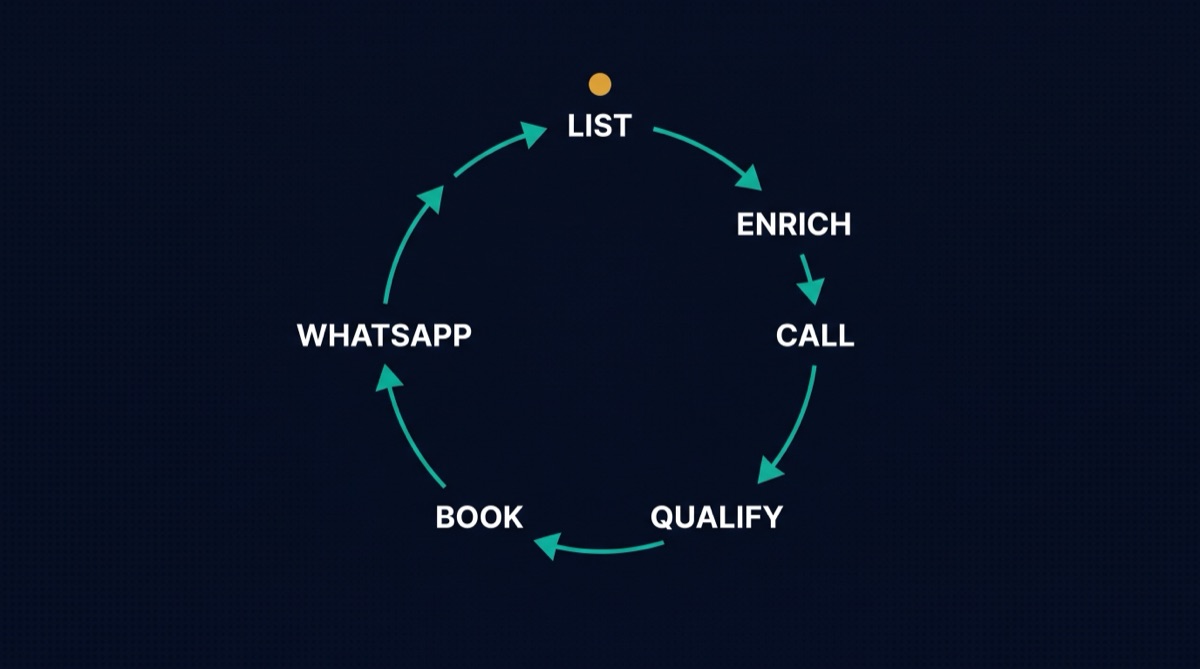
That is the whole arc. Interrupt, name the problem, qualify, book, confirm. Everything else is just doing it enough times to get good at it.
Set your expectations honestly
Let me give you real numbers, because false hope helps no one.
On any single cold dial, most calls do not connect. Industry data puts the connect rate low, often only a handful of conversations per dozens of dials, and it can take several attempts to reach one decision-maker. That is normal. It is why the list quality and the follow-up matter so much more than raw call volume.
So do not measure a day by dials. Measure it by conversations had and meetings booked. A morning of forty dials that produces three real conversations and one solid meeting is a good morning, even though thirty-plus calls went nowhere. That is the maths of cold outreach, and once you accept it, the work gets a lot calmer.
This is also why I never let cold calling stand alone. Paired with LinkedIn and WhatsApp, the same list produces far more conversations than the phone alone ever would.
Where cold calling sits in the bigger machine
Cold outreach is not my whole system. It is one entry point into it.
Most of my work builds inbound pipeline: paid media and offers that make qualified buyers raise their hand on their own. Cold outreach runs alongside that, for the accounts I specifically want and cannot wait for, or to warm a market before the ads even start.
Both roads lead to the same place: a qualified, booked meeting, run through the same appointment setting system so it actually shows up. The channel that opened the door matters less than the machine that carries the prospect the rest of the way.
Get the list right, open like a human, qualify fast, book instead of close, and follow up on WhatsApp the same minute. Do that, and cold calling stops being a numbers game you dread.
It becomes one more reliable way to fill your calendar.