 Ahmed Elflal
Why most GCC lead generation quietly fails
Let me start with the pattern I see over and over.
A company decides it needs more leads. So it starts with the ad. Someone picks an audience, writes a headline, boosts a post, and waits.
The leads come in. Most of them are junk. The sales team stops answering them. Everyone concludes that paid media does not work in the Gulf.
That is almost never the real problem.
The real problem is that they started at the wrong end. The ad is the last thing that should be built, not the first. Underneath a bad campaign there is usually a weak offer nobody feels any urgency to claim, and no qualification, so the sales team is buried in people who were never going to buy.
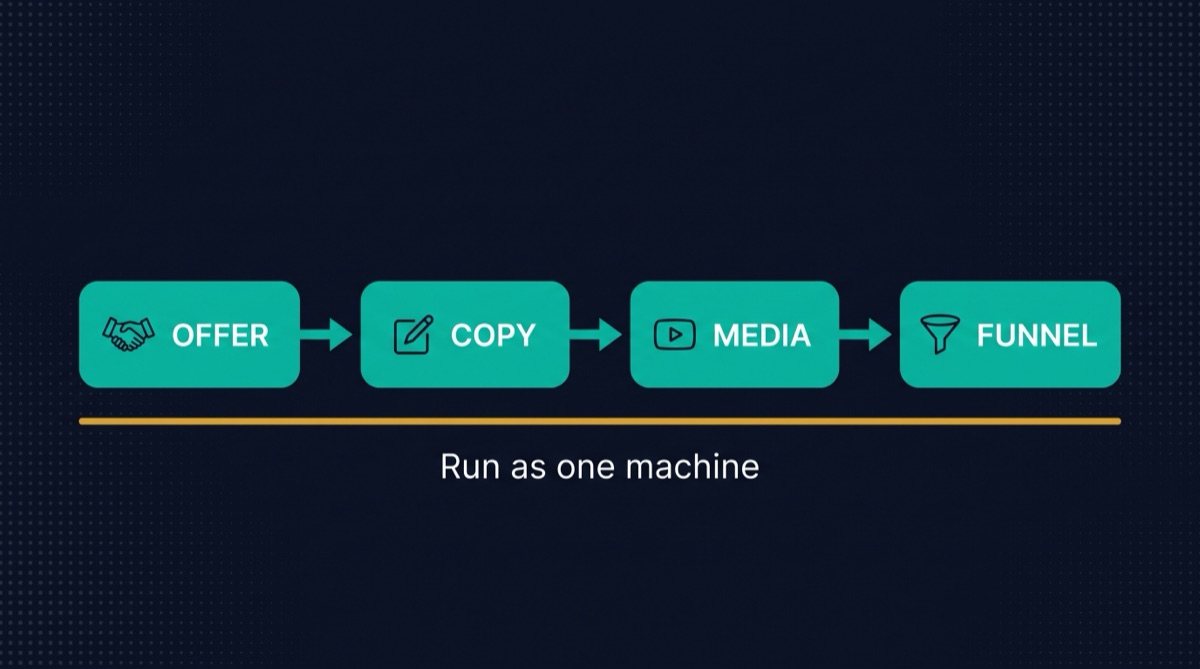
So I build in a specific order, from the ground up. Offer, then copy, then media, then funnel. Each layer gives the next one something solid to stand on. That order is the whole method, and it is what makes the difference between a B2B lead generation agency that sends you noise and one that sends you meetings. Here is how I run each layer.
Layer 1 — the Offer
Nothing else matters if the offer is weak.
Before I write a single ad, I engineer the offer, because the offer is what people actually respond to. A brilliant ad for a boring offer still fails. A plain ad for an irresistible offer still works.
The way I judge an offer is simple. I ask whether the perceived value is high enough that saying no feels like the harder choice. There is an old value equation behind this: dream outcome and the odds of hitting it, weighed against the time it takes and the effort or sacrifice involved. Push the first two up, pull the last two down, and the offer gets stronger on its own.
In practice I run the offer through what I call the 5Ts, five levers I can pull to make it land:
Type. What it actually is. Product, service, or program, stated in one line with zero confusion about what the buyer is getting.
Transformation. The specific outcome they are buying. Not features, not activity. Where they are now, where they end up.
Trust. Why they should believe me. Proof, credibility, and a real reason the outcome will happen, so a nice promise becomes a credible one.
Time. Why it is relevant now. Real market context, not fake urgency, because fake urgency poisons the trust I just built.
Ticket. The price, doing real work. Priced right, it filters seriousness early and sorts the committed buyer from the tire-kicker before the call.
I do not move to copy until the offer passes this test on its own, without clever words propping it up. If you want the deeper version of this, the full breakdown lives in how I engineer offers, and it sits at the heart of my GCC lead generation playbook. Get the offer right and everything downstream gets easier.
Layer 2 — the Copy
Once the offer is solid, I give it words.
The job of the copy is not to be clever. It is to make the right person stop, feel understood, and want what the offer gives them. In a feed full of noise, most ads lose in the first second because they never earn attention.
So I write around what I call the Triple Hook: three things the copy has to land, fast, in this order.
Hook the attention. The first line exists to stop the scroll. It calls out the exact person and names the pain or the desire in their own words, not mine. If it reads like an ad, it is already dead.
Hook the interest. Once they have stopped, I hold them by showing I understand the problem better than they expected. This is where I agitate the real cost of the problem and hint that there is a better way.
Hook the desire. Then I point all of that at the offer. Here is the outcome, here is why it is believable, here is the small next step. The call to action is low pressure and specific, never a shouty "buy now".
Attention, then interest, then desire. Miss the first and the other two never get read. That is why the hook does most of the work, and why I write ten versions of the first line before I am happy with one.
Layer 3 — the Media
Now the offer and copy have somewhere to go.
People expect this layer to be complicated. It is the opposite. I keep the ad account structure as simple as it can possibly be, because complexity is where budget goes to die.
In practice that means one consolidated campaign using budget optimisation at the campaign level, letting the platform move money to whatever is working, rather than a sprawl of tiny ad sets I try to micromanage. One campaign, broad targeting, and the budget pooled so the system has room to learn.
Then I feed that campaign creatives, not audiences. I load in 10 to 20 varied creatives: different hooks, different angles, different formats, and let delivery find the winners. The creative is the real lever now.
This is deliberate, and it matches where the platforms have gone. Meta's Andromeda update moved delivery toward being creative-based rather than audience-based, which means the machine now reads the creative to decide who sees it. In plain terms, your targeting increasingly lives inside the ad itself. So I stop hand-picking narrow audiences and instead give the system a rich spread of creatives and let it do the matching. That single shift is why the consolidated, creative-fed structure outperforms the old fifty-ad-set approach. I go deeper on the mechanics in how I buy media.
Layer 4 — the Funnel
The media brings people in. The funnel decides who reaches your sales team.
This is the layer most campaigns skip, and it is the one that separates a lead machine from a spam machine. Without it, every click becomes a "lead", including the students, the browsers, and the people who will never have the budget. Your sales team burns out chasing ghosts.
So I build qualification into the funnel itself, before anyone reaches a human. The filter I use is BANT, four checks that decide whether someone is a real buyer: Budget, whether they can afford the fix; Authority, whether they can actually say yes; Need, whether there is a genuine problem I solve; and Timing, whether they want it soon rather than someday.
I ask just enough on the way in to run those checks quietly, so the wrong people sort themselves out before they ever book. The right people flow through; the rest are politely filtered. Done well, this is what lets me hand a sales team calls where roughly 60 to 95% of the people who arrive are genuinely sales-ready, depending on the offer and how tight I set the filter.
The full mechanics of this, and the exact questions I use, live in my BANT qualification guide. And once a lead is qualified and books, the job is not done. The appointment setting system behind it confirms and reminds, so the calls actually show up instead of ghosting on the day.
The results this method produces
Let me put numbers to it, because a method is only worth what it returns.
When the four layers are built and tuned, a Gulf funnel like this tends to land cost per qualified lead somewhere around 50 to 60 dollars. That is per qualified lead, not per raw click, which is the number that actually matters.
On return, once the system has learned and the offer is proven, I have seen return on ad spend land anywhere from 4 to 11 times. The range is wide on purpose, because it moves with your price point, your close rate, and your sales process. A high-ticket B2B offer with a sharp closer sits at the top of that range; a newer offer still finding its feet sits lower.
I want to be honest about the shape of it. The first leads usually show up within a week or two, because paid media buys attention quickly. But the numbers you can plan around take a few weeks to settle while delivery learns and I rotate in fresh creatives. Early spikes and dips are noise, not signal.
And I never optimise for the cheapest lead. A 20 dollar lead that never buys is more expensive than a 60 dollar lead that closes. So the number I actually chase is cost per closed deal, and every layer above exists to pull that number down.
Why the order is the whole point
If you take one thing from this, take the sequence.
Offer, copy, media, funnel. Build them in that order and each layer reinforces the next. Build them out of order, or skip one, and the machine leaks exactly where you were not looking.
This is the transparent version of what you would pay a B2B lead generation agency to run for you. There is no secret sauce hidden in a black box. There is a strong offer, honest copy, a simple media structure fed with plenty of creative, and a funnel that qualifies hard so your sales team only ever talks to buyers.
That is the method. If you want it built and run as one machine, measured in pipeline rather than clicks, that is exactly what I do. You can see the full system or book a strategy call and we will talk about your offer first, because that is always where it starts.