 Ahmed Elflal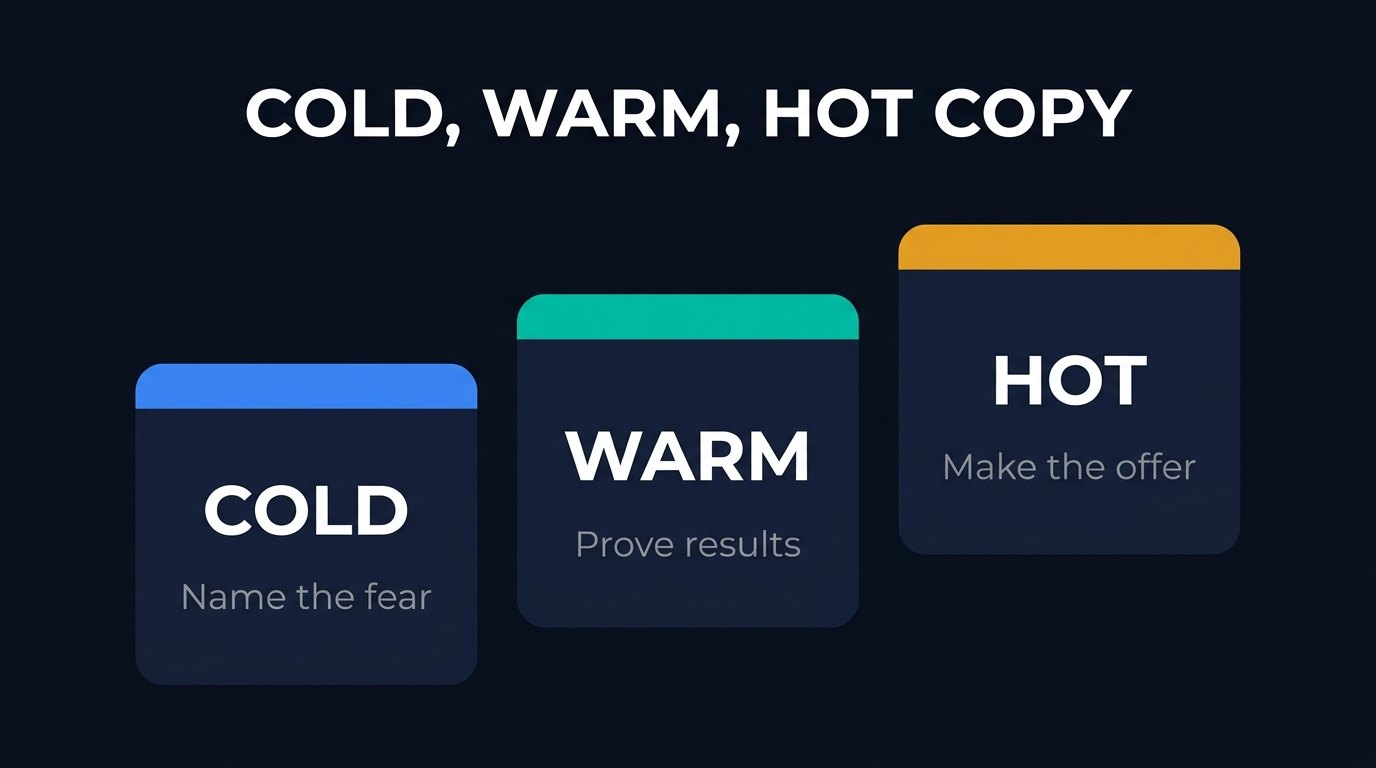
The same offer can crush with one audience and quietly die with another.
The reason is usually not the offer.
It is that the copy was written for the wrong temperature.
A message that lands on a ready buyer falls flat on a stranger.
And a message that warms a stranger bores someone who is ready to buy right now.
Temperature, not demographics, decides the message
"Temperature" just means how close someone is to buying.
Cold: never heard of you.
Warm: knows you, weighing it.
Hot: ready to act.
Two people with the same job title can need completely different copy. One has never heard of you. The other is on your pricing page.
Awareness and trust decide what to say. Not age or industry.
And the four drivers behind every buyer, their FRED (Fears, Results, Expectations, Desires), map cleanly onto the three temperatures.
Cold: name the fear and the problem
A cold audience does not know you and is not thinking about your solution.
So do not pitch.
Open with a hook that stops the scroll. Then name the problem and the Fear so precisely they feel understood.
This is where the Triple Hook earns its keep: a bold premise, why it matters, and a contrarian twist.
The goal of cold copy is recognition. Not a sale.
Warm: address expectations and prove results
A warm reader knows you and is weighing whether this is real.
Now you address their Expectations. How long, how much effort, what the process looks like.
And you bring proof of Results. Real numbers. Real names. The mechanism behind them.
Warm copy answers one question: "can I trust this, and will it work for me." So you lead with evidence and clarity.
Hot: speak to desire and make the offer
A hot reader is ready.
Do not re-explain the problem they already feel. Do not re-prove what they already believe.
Speak to the Desire. The outcome and the identity they are reaching for.
Then make the offer cleanly, strip the friction, and give an honest reason to act now.
Over-explaining to a hot audience talks them out of a decision they had already made.
One idea, three expressions
The skill is taking a single core idea and saying it three ways.
As a fear and a problem for the cold.
As proof and expectations for the warm.
As desire and an offer for the hot.
Same truth. Different doorway.
When you can do that, the whole funnel sings one consistent message instead of three disconnected campaigns.
The most common mistake
Running hot copy at a cold audience.
The "book a call now" ad blasted to people who have never heard of you.
It converts almost nobody. And it teaches you the false lesson that the offer is broken.
Match the temperature first. Then judge the offer.
The GCC nuance
Language and trust shift by temperature here too.
Cold audiences in the Gulf often respond best to the problem framed in the language they think in.
Proof and authority carry the warm stage, especially in markets where trust is built before business.
Test Arabic and English by stage, rather than assuming one wins everywhere.