 Ahmed Elflal
Most people treat WhatsApp like a megaphone.
Blast an offer to a list, hope someone replies, get their number blocked. That is not a strategy. That is noise, and in the Gulf it burns trust fast.
I treat WhatsApp marketing as something else entirely: a framework. A structured way to move a stranger to a lead, a lead to a booked call, and a customer to a retainer, one message at a time, each one triggered by where the person actually is.
Because here is the thing about the Gulf. Over 90% of UAE smartphone users open WhatsApp every single day. A message there gets read in minutes. That is not a channel you use to shout. It is a channel you use to build a relationship and monetize it properly.
Let me walk you through how I actually do that, from the first opt-in all the way to a recurring retainer.
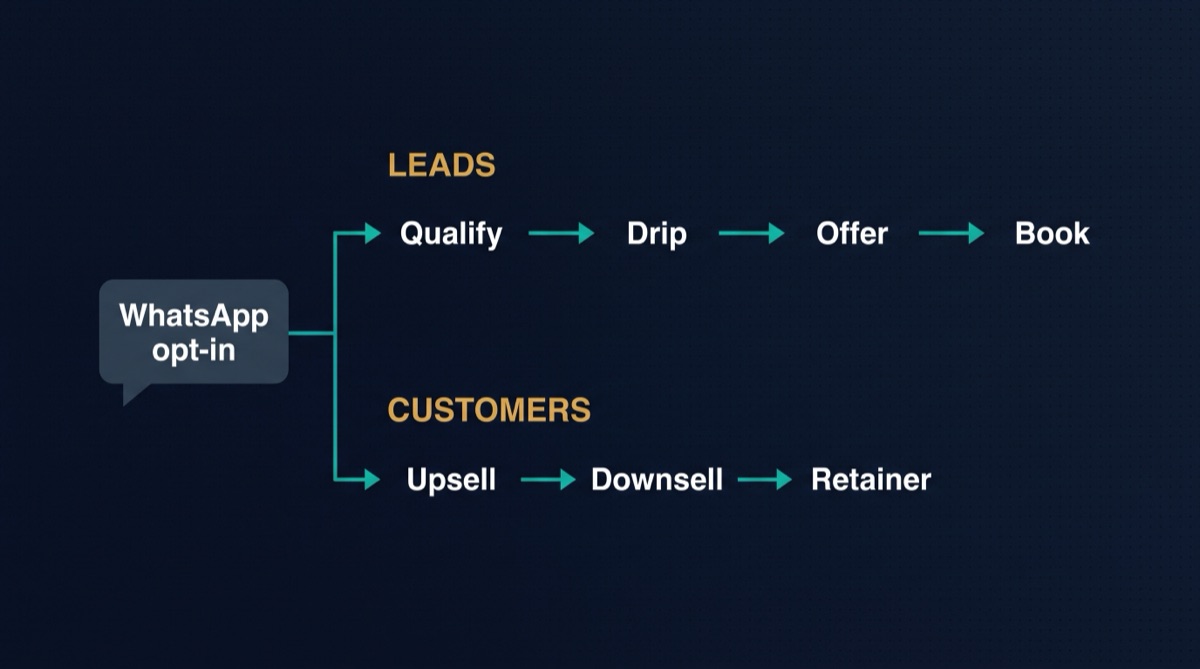
Start here: is this a lead or a customer? The one fork that changes every message
Before I write a single WhatsApp message, I ask one question about the person on the other end.
Have they paid me yet, or not?
That is the whole fork. And it changes everything downstream.
If they have not paid, they are a lead. The job is to qualify them, earn trust, hand over value, and book the call. Nothing about revenue yet, just the path to the first yes. Push a hard sell here and you lose them.
If they have paid, they are a customer. Now the job flips. The relationship exists, the trust is banked, so the work is to make that customer more profitable and keep them longer: sell them the next thing, save the sale when they wobble, and turn a one-off project into something recurring.
Same channel, two completely different playbooks. Send a retainer pitch to a cold lead and you frighten them off. Send a beginner nurture drip to a paying client and you waste the relationship you already earned.
So on every contact, the first thing my system checks is a CRM tag: lead or customer. Everything after that is just running the right sequence for the right side of the fork. The rest of this guide is those two sequences.
The WhatsApp rules that shape timing (you cannot map messaging without these)
Here is what trips up almost everyone new to WhatsApp marketing: you do not get to message whoever you want, whenever you want. Meta built rules into the platform, and those rules decide what you can send and when. Learn them first, because they shape the entire map.
There are three you need to hold in your head.
The 24-hour session window. When a customer messages you, a 24-hour window opens. Inside it, you can reply freely with normal service messages, and they are free. The second someone messages your business, the clock starts. When the 24 hours run out, that door closes, and to message them again you need a pre-approved template.
The message categories. Outside the window, every message you send falls into a category Meta charges and governs differently. Marketing messages are promotions, offers, and nudges; they need explicit opt-in and they are priced the highest. Utility messages are triggered by something the customer did, like a booking confirmation or a payment receipt; they are cheaper and do not need a marketing opt-in. Authentication messages are one-time passcodes. Service messages are the free replies inside that 24-hour window.
Explicit opt-in. Before you send any marketing message, the person has to have clearly agreed to hear from you. Not a pre-checked box buried in a form. A real, active choice, which in the Gulf is also the law, and I will come back to that.
Why does this matter for the framework? Because timing is everything. The cheapest, warmest moment to sell is inside the 24-hour window, when the customer just messaged you. The most expensive is a cold marketing template out of the blue. So the whole art is building sequences that ride the free window where possible and use paid templates only when they earn their cost. Keep that in mind as we go.
If it is a LEAD: the nurture sequence
Start with the person who has not paid yet. The lead. Here the goal is simple: get them qualified, warm them up, and book the call. Revenue comes later. Trust comes first.
I run leads through four moves.
Qualify with a quick WhatsApp Flow. The moment a lead opts in, usually from a click-to-WhatsApp ad, I do not launch into a pitch. I send a WhatsApp Flow: a small in-chat mini-app that asks a few questions right inside the thread. Budget, timeline, the problem they are trying to solve. It is the same filter I would run on any funnel, just happening in the chat. Because they messaged me, this all runs inside the free 24-hour window. If you want the deeper logic behind those questions, it is the same one I lay out in my guide to qualifying leads with BANT.
The value drip. A qualified lead is not always a ready lead. So over the following days I drip real value: a short insight, a relevant case, a quick answer to the question they did not know to ask. Not offers. Value. Each message earns the next one. In the Gulf this beats email hands down, because a WhatsApp note gets read while an email waits.
Your offering. Once trust exists, I make the first move that costs them nothing to say yes to. This is where my offering comes in, the one designed to turn a stranger into a customer: a Giveaway, a Win-Your-Money-Back guarantee, a Buy-X-Get-Y-Free, a Decoy that makes the real offer look obvious, or a Pay-Less-Now nudge. The point of the offering is not the margin. It is to get the first yes with as little friction as possible.
Book the call. The whole nurture points at one thing: a booked, confirmed call. WhatsApp is where I book it and where I hold it, with the confirmations and reminders that lift show-up rates. That handoff is exactly what I cover in my appointment setting guide, and WhatsApp is the channel that makes those reminders actually land.
That is the lead side. Qualify, drip, attract, book. Every message riding the window where it can, every offer sized to lower resistance, not raise revenue. Yet.
If it is a CUSTOMER: the offers that grow the account
Now the fun part. The person has paid. Trust is banked. This is where WhatsApp stops being a nurture channel and becomes a revenue channel.
I ground all of this in my own offer framework, the one I build every engagement around. Once someone is a customer, three families of offers do the heavy lifting: upsells to make them more profitable, downsells to save a sale that is slipping, and retainer offers to turn them into recurring revenue. Here is how each one maps onto a WhatsApp moment.
Upsell: make the customer more profitable
An upsell sells more to someone who already bought. The best time to do it is right after a purchase, when they just messaged you and the free window is wide open. Four shapes work.
The Classic upsell is the "you cannot really buy Y without X" move. They booked the audit; the audit only pays off with the implementation, so I offer the implementation. A single WhatsApp message inside the window, at the exact moment they are most bought-in.
The Anchor upsell shows the expensive thing first. Before I present the option they will take, I show them the full-scope, top-tier version. Against that anchor, the sensible package feels like the easy choice. On WhatsApp I lay the anchor out clearly, then let the real offer land next to it.
The Menu upsell is my consult-in-a-message. I gently unsell the wrong option, prescribe the right one, and give them a clean A or B to choose from. It respects them and it converts, because the choice is theirs, not mine.
The Rollover upsell credits something they already paid for toward the bigger thing. "The audit fee comes straight off the build." It removes the sting of paying twice, and it is an easy, warm message to send right after their first purchase clears.
Downsell: save the sale
Not every customer says yes to the full offer. A downsell keeps the sale alive instead of losing it entirely. When someone hesitates on WhatsApp, I do not walk away. I reshape the offer.
The Payment Plan downsell keeps the price the same but splits it. If the number is the wall, I break it into instalments in a single message and the wall usually comes down.
The Trial-with-Penalty downsell lets them start small, with a gentle cost to walking away, so there is skin in the game without the full commitment up front. It is a good message for a customer who is interested but not yet certain.
The Feature downsell strips the offer from high value to low, removing pieces until the price fits. Rather than lose them, I offer the lean version now and leave the door open to the rest later. On WhatsApp, that is one honest message that saves a relationship.
The retainer
This is where a project becomes a business. Retainer offers turn a one-off customer into recurring revenue, and WhatsApp is where I make the ask, because by now they already talk to me there daily.
The Bonus retainer offer adds something extra for staying on: an ongoing report, priority access, a monthly strategy touch. The retainer buys them more than the work, and I frame that in the message.
The Discount retainer offer rewards commitment: pay in full for the quarter and save, a loyalty rate for staying, or a grandfathered price that only holds while they stay subscribed. It makes continuing the obvious financial choice.
The Waived-Fee retainer offer drops the setup or onboarding fee when they move onto the retainer. The barrier to continuing disappears, and the recurring relationship starts clean.
That is the customer side of the framework. Upsell to grow the account, downsell to save it, a retainer to keep it. All of it delivered in the one place your GCC customer already lives.
The messaging map: what to write, when, and which tool
Here is the whole model on one page. Read it top to bottom and you are watching a stranger become a lead, a lead become a customer, and a customer become a retainer, with the right message, at the right moment, in the right category.
| Moment | Trigger (when) | Message (what) | Category · tool (how) |
|---|---|---|---|
| Lead opts in | Taps a click-to-WhatsApp ad | Warm welcome and a single qualifying question to open the thread | Service · opens the 24h window in GoHighLevel |
| Qualify | Right after opt-in, in the window | A short in-chat form for budget, timeline, and need | Service · WhatsApp Flow |
| Value drip | Days 1 to 5 while warming | One useful insight or case per message, no offer | Utility / template · GoHighLevel sequence |
| Offering | Once the lead is warm and qualified | A no-friction first offer, e.g. Giveaway or Buy-X-Get-Y-Free | Marketing · approved template |
| Book the call | Lead accepts the offer | Booking link, then confirmation and reminders | Utility · template, then service in-window |
| Upsell | Right after purchase, window open | Classic or Anchor offer for the next logical step | Service · free reply in the 24h window |
| Downsell | Customer hesitates on the upsell | Payment Plan or Feature offer to save the sale | Service · free reply in the 24h window |
| Renewal / retainer | Project nears its end | Bonus or Discount retainer offer to go recurring | Marketing · approved template |
Notice the pattern. The warm, free service messages do the selling inside the 24-hour window, right after a customer acts. The paid marketing templates only come out when there is no open window and the offer clearly justifies the cost. That is the framework working with Meta's rules, not against them.
The stack: what actually runs this
None of this works on a personal WhatsApp and a spreadsheet. It runs on a real stack, and it is not complicated.
The WhatsApp Business API through GoHighLevel. GoHighLevel is my CRM, and it connects to the official WhatsApp Business API for UAE and Saudi numbers. That gives me approved template messages, automated sequences, and contact records in one place. Every opt-in, every reply, every offer sent lives in the same system, so nothing gets lost and nobody gets messaged twice.
WhatsApp Flows for qualification. Flows are the in-chat mini-apps I mentioned: budget, timeline, need, answered inside the thread without the lead ever leaving WhatsApp. They turn qualification from a chore into a two-tap experience, and they run inside the free window.
CRM tags for lead versus customer. This is the quiet backbone of the whole model. A single tag, lead or customer, decides which sequence a contact receives. When a lead pays, the tag flips, and they move from the nurture playbook to the customer playbook automatically. The fork I opened this guide with is not a mindset, it is a field in the CRM doing real work.
That is the entire stack. One CRM, the official API, Flows for qualification, and one tag that routes everyone. If you want to see how this plugs into the wider machine of ads, offers, and follow-up, that is what I lay out across my GCC lead generation playbook.
Staying compliant in the GCC
This part is not optional, and it is where a lot of imported WhatsApp advice gets people in trouble. The Gulf has real rules. I follow them, and so should you.
Explicit opt-in is the law, not a nicety. Under the UAE's Personal Data Protection Law, Federal Decree-Law No. 45 of 2021, you need explicit consent before you send a marketing message. That means an active, clear yes, not a pre-checked box someone forgot to untick. The clean way to capture it is the click-to-WhatsApp ad or a form where the person actively starts the conversation, which gives you consent and opens the free window in one move.
Template approval. Every marketing and utility message you send outside the 24-hour window has to be a template Meta approved in advance. You cannot freestyle a promotional blast. I write templates that are useful and clear, submit them, and only send once they pass. It keeps the account healthy and keeps me out of the spam pile.
Marketing versus utility cost. Because marketing templates are priced highest and utility templates cheaper, compliance and economics point the same way: send marketing only when it earns its cost, and lean on utility and free service messages for everything else. Following the rules is also the cheaper way to run.
Keep the record. I log consent for every contact and honour every request to stop, immediately. It protects the client, it protects me, and honestly, in a region where trust is the whole game, it is just how you should operate.
Do this properly and WhatsApp marketing is not a legal risk. It is one of the safest, most respectful channels you have, precisely because the person chose to be there.
Where this fits, and how to start
WhatsApp is not my whole system. It is the connective tissue of it, the channel where qualification, booking, follow-up, and revenue all actually happen, because it is where the Gulf buyer already is.
The fork is the whole idea. Lead or customer. Get that right, run the right sequence for the right side, ride the free window where you can, respect the opt-in and the rules, and WhatsApp stops being a place you shout offers into. It becomes a framework that moves people from stranger to retainer, one earned message at a time.
If you would rather have this built for you than build it yourself, that is exactly the kind of system I put together. You can see how the whole machine works, or book a strategy call and we will map your version of it.