 Ahmed Elflal
Every agency I have taken over from said the same proud thing.
"We are getting you loads of leads."
And every time, the sales team was drowning in the wrong ones.
Tire-kickers. Students. People who forgot they ever filled in a form.
Volume is easy. Volume is also worthless if nobody in the pile can buy.
Lead qualification is the discipline that fixes this. It is also the link in the chain most companies skip entirely, and then wonder why their close rate is on the floor.
Let me give you the whole thing: what qualification is, the four checks, where to run them, and the two systems that deliver them.
What lead qualification actually is
Lead qualification is the act of deciding, before you spend a sales call, whether a lead can actually buy.
That is it. A yes or no, made early, on purpose, with a clear rule.
You will hear two bits of jargon around this, so let me kill the confusion now.
An MQL, a marketing qualified lead, is someone who looks interested enough that marketing thinks sales should look.
An SQL, a sales qualified lead, is someone sales has checked and agreed is worth a real conversation.
The whole job of lead qualification is to move people from the first to the second cleanly, without wasting your closers on anyone who was never going to buy.
BANT: the four checks that define a real buyer
You cannot filter for a buyer you have not defined.
So before anything else, write down exactly who counts. There is an old sales shorthand for it, BANT. Forget the acronym, just read the four questions.
Budget. Can they afford it? Not "do they love it." Can they pay.
Authority. Can they say yes themselves, or do they have to ask three other people first?
Need. Do they actually have the problem you solve, right now?
Timing. Do they want it fixed soon, or "someday"?
Four yes-or-no questions. A real buyer is a yes on all four.
Miss one, and they are not a bad person. They are just not ready.
And they should not be eating your sales team's time.
One honest update, because the world moved. Buying committees got bigger. The single decision-maker is rarer now; often three or four people sign off together. So "Authority" today means finding your champion and knowing who else has to nod, not hunting for one all-powerful buyer.
Define the right buyer before BANT: the FRED layer
BANT tells you if a lead can buy. It does not tell you who to go after in the first place.
That is a different question, and getting it wrong means you qualify hard against the wrong crowd.
So before the four checks, I define the buyer with a lens I call FRED. Four drivers underneath every B2B decision.
Fears: what keeps them up at night.
Results: the outcome they actually want.
Expectations: what they assume working with you will be like.
Desires: the deeper want under the practical one.
Get FRED right and your offer and ads pull the right people in, so lead qualification has less junk to reject in the first place. I go deep on it in the FRED framework.
Attract right, then qualify. Not the other way around.
Build the filter into the form, not the phone call
Here is the mistake nearly everyone makes.
They run ads. They collect whoever opts in. They book all of them onto calls.
And only then, live, mid-call, they find out half have no money and no power to decide.
They paid for the lead. Then they paid again, with a wasted half hour.
Flip it.
The four checks get built into the funnel itself. Into the form. Into the page.
So the wrong people are filtered out on the way in, before they ever reach a human.
The lead shows up already sorted. Your team only ever speaks to people who passed the test.
And there are two ways to build that filter. Which one you use comes down to one thing: what you sell.
The two delivery systems, and how to pick yours
If you need volume: the instant-form system
An instant form is the quick form that opens right inside Facebook or Instagram. The person never leaves the app.
It is cheap and fast. But that same easiness lets low-intent people slip through.
So you put the qualifying questions straight into the form. Simple logic turns away the junk before it ever reaches your CRM, the place your leads are stored.
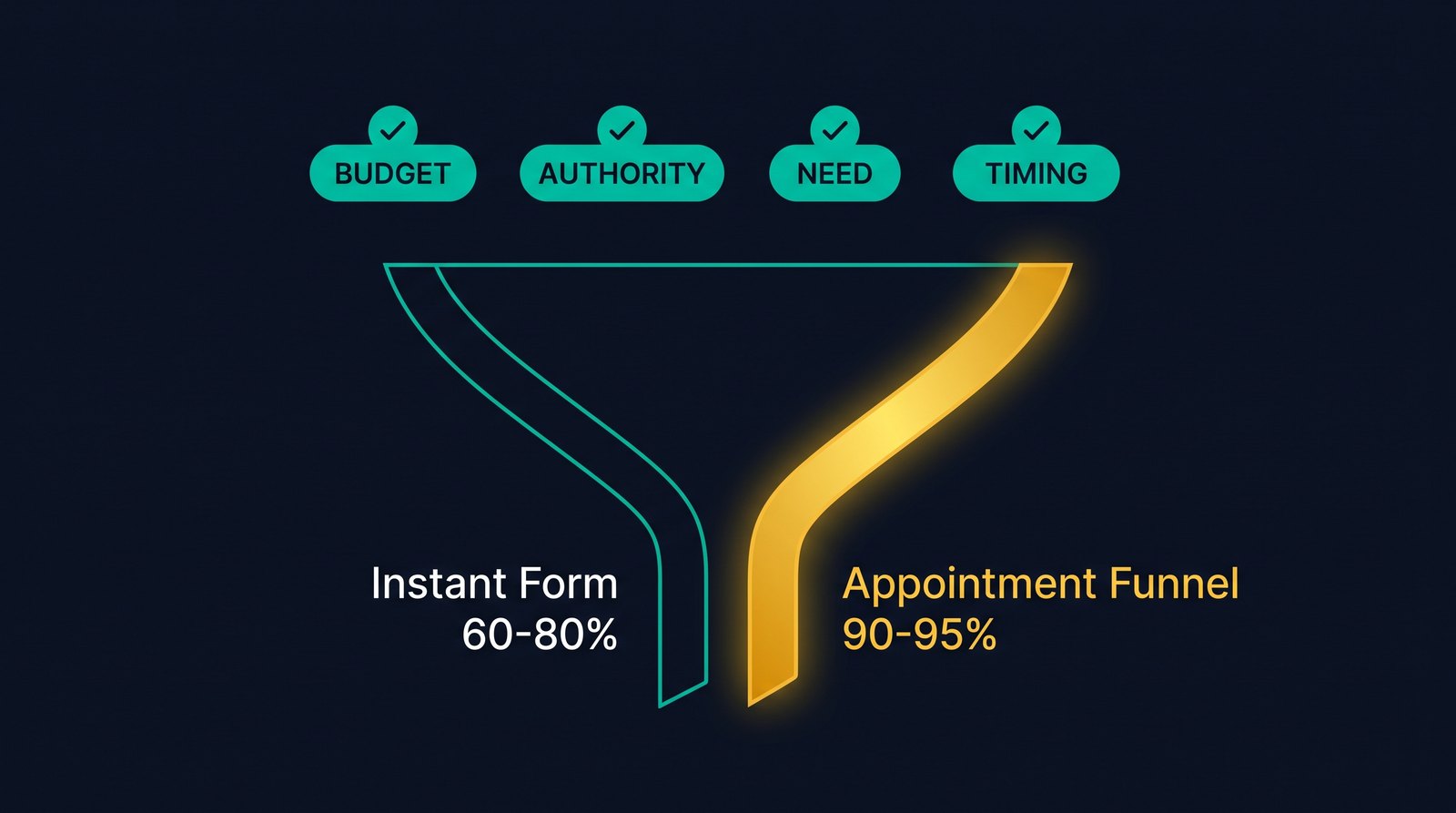
This path runs 60 to 80% qualified. Use it when you need steady volume at a low cost, for lower-priced offers and higher numbers.
If you sell high-ticket: the appointment system
When one deal is worth a lot, you want fewer leads but much higher quality.
So instead of a quick form, the prospect reads a longer page that warms them up, fills in a short qualification form, then books a call. A reminder sequence gets most of them to actually show up.
By the time your team is on the call, the prospect understands what they are buying. The conversation is about how to start, not whether to.
This path pushes qualification toward 90 to 95%. The full build is in the appointment setting guide.
Same four checks underneath. Different machine on top.
Small and frequent goes to the instant form. Big and considered goes to the appointment funnel.
Lead scoring, without overcomplicating it
You do not need a fancy system to score leads. You need a simple, honest one.
Give points for the things that signal a real buyer. A senior role gets more than a junior one. A budget that fits gets more than one that does not. A problem they say is urgent gets more than a "just researching." An engaged lead, one who watched the video and read the page, gets more than a cold form fill.
Add it up. Above a line, they go straight to a call. In the middle, they go to nurture. Below it, they get a polite no or a long, light follow-up.
The point of scoring is not precision. It is to stop your team guessing, and to make sure your best closers spend their hours on the highest-scoring leads, not whoever happened to reply first.
Keep it simple enough that a human can run it on a busy day. A scoring system nobody uses is worse than none.
Nurture: what to do with the not-yet-ready
Most leads are not a no. They are a "not yet." Timing is the one BANT check that changes on its own, so the not-yet-ready are your cheapest future pipeline.
Nurture is how you stay in their world until their timing turns on.
It is not a hard-sell drip. It is the same trust-building you do at the top of the machine, pointed at people who already raised a hand. A useful message now and then. A piece of proof. A check-in that does not beg.
The goal is simple: be the name they think of on the day the need becomes urgent. Then a quick message moves them from nurture to a booked call, and they convert far cheaper than any cold lead ever would.
Disqualified today does not mean gone forever. It means not now, kept warm.
The numbers that prove lead qualification is working
Four numbers tell you whether your filter is set right.
Qualification rate: of the leads that reach a call, how many were a genuine fit. With the systems above, expect 60 to 80% on instant forms and 90 to 95% on the appointment funnel. Low means your form lets too much through.
MQL to SQL conversion: of the leads marketing passed, how many sales agreed were worth a real conversation. If this is low, marketing and sales disagree on what a buyer is, and you need to align the definition.
Cost per qualified lead: what you pay for one lead that actually passes the checks, not one raw form fill. This is the number that matters, because raw leads are vanity.
Sales time saved: softer, but real. When lead qualification works, your closers stop burning hours on calls that were never going to close, and the close rate climbs on its own.
Saying no on purpose is the part nobody expects
Most people hate disqualifying a lead. It feels like setting money on fire.
It is the opposite.
The one resource that actually closes deals is your sales team's attention. Every unqualified call burns a little of it.
So the not-yet-ready people get nurtured until their timing changes.
The never-going-to-fit people get a polite no.
And everyone left over gets a fast, focused conversation.
Protect the attention, and the close rate climbs on its own.
The one thing that quietly ruins good qualification
You can do everything above perfectly and still lose, if you are slow.
A lead that felt hot the second they opted in is a cold, half-interested stranger two days later. The fit did not change. The moment did.
So call within minutes, not hours. Fire off a message the second they come in, then follow up like you mean it. In the Gulf, that first touch belongs on WhatsApp, where it gets seen.
The quality you built upstream only pays off if you reach them while it is still warm. For a shorter, hands-on version of this, see how I keep up to 95% qualified.