 Ahmed Elflal
The one rule before any of these B2B lead generation strategies
Qualification before volume.
That is the rule, and it decides whether the other fourteen make you money or just make you busy.
Every B2B lead generation strategy below can produce more leads. Only some of them produce leads worth calling.
So read this as a menu, not a checklist.
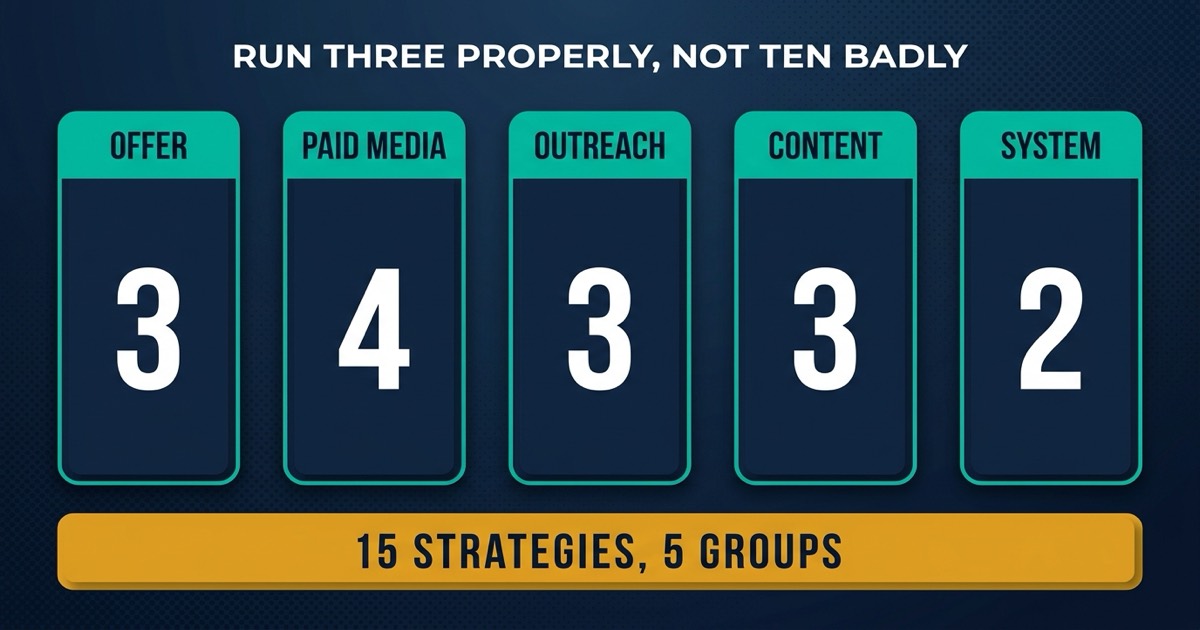
I would run three or four of these properly before running ten badly, especially in a market as small as the Gulf, where spreading budget thin means nothing gets enough signal to learn from.
These are grouped by layer, because that is how they actually connect: the four-layer system is offer, copy, media, funnel, and every tactic here sits inside one of them.
Offer and positioning: lead generation strategies 1 to 3
1. Engineer the offer before touching a channel.
This is roughly 80% of your result.
Nobody wants to book a call with a stranger, so build something that solves a real slice of the problem on its own: an audit, a benchmark, a diagnostic.
I engineer each one against the 5Ts, which are Type, Transformation, Trust, Time and Ticket.
The full method is in how I engineer offers.
2. Lead with risk reversal.
Gulf B2B buyers have usually been burned by an agency before you arrive.
That is the real objection, and it is rarely spoken aloud.
A guarantee, a paid pilot, or a clearly bounded first phase removes more friction than another testimonial ever will.
3. Niche down by vertical.
"We do lead generation" competes with everyone.
"We do lead generation for GCC SaaS companies" competes with almost nobody.
The narrower claim converts better and costs less to advertise, because relevance is what the algorithm is now pricing.
Paid media: lead generation strategies 4 to 7
4. Run a simple consolidated structure.
One campaign, budget at campaign level, one or two broad ad sets.
Stacking fifteen interest audiences does not just fail to help now, it actively fights the algorithm.
5. Feed it 10 to 20 genuinely different creatives.
Meta's Andromeda delivery system moved targeting from audiences to creative, and Meta's own data attributes roughly 56% of campaign performance to creative quality.
So creative volume is the new targeting.
And it has to be variation, not iteration: different concepts, not the same ad with a new headline.
That distinction is the whole of how I buy media.
6. Retarget warm audiences separately.
Site visitors, video viewers past 50%, form openers who never submitted.
These people already know you, so they deserve different copy and a lower cost per acquisition than cold traffic.
7. Capture intent on Google.
Meta creates demand, Google captures it.
Someone typing "lead generation agency Dubai" is further down the path than anyone you interrupted on a feed.
Volumes are small in this region, which makes the intent worth more per click, not less.
Outreach and follow-up (strategies 8 to 10)
8. WhatsApp nurture, not email nurture.
This is the one I would fight hardest for, and it is where most imported playbooks break.
Gulf decision-makers run their working day from their phone. A WhatsApp thread gets read.
A formal email gets filed.
The gap between those two is not small.
Email still has a job for longer-form nurture and anything needing a paper trail.
But for turning a warm lead into a booked call in this region, WhatsApp wins consistently in my campaigns.
9. Speed to lead.
The first message should go out in minutes, not the next working day.
Interest decays fast, and in a market where your competitor is also fast, the second responder usually loses.
10. Cold outreach that feeds appointment setting.
Inbound is capped by how many people are searching this month. Outreach is how you create conversations that would not otherwise exist.
Two constraints matter here.
Since August 2024, UAE telemarketing has been regulated under Cabinet Resolution 56 of 2024, which requires prior TDRA approval, a 9am to 6pm calling window, screening against the Do Not Call Registry, and locally registered numbers.
Treat it as binding on B2B calling: it is written in consumer-protection language with no express carve-out.
The second constraint is that outreach without a booking mechanism is just noise.
It has to hand off cleanly into appointment setting, or the conversations evaporate.
The cold-open craft itself is in how I run cold outreach.
Content and authority (strategies 11 to 13)
11. Publish the playbook, not the brochure.
Content that shows the actual method outperforms content that describes a service.
It is also the only kind that earns citations from AI answer engines, which increasingly sit between your buyer and your site.
The counterintuitive part: giving away the method does not cost you clients.
Most readers will not build it themselves, and the ones who do were never going to hire you.
12. Case studies with real numbers.
A named outcome with a figure attached beats three paragraphs of adjectives. If you cannot name the client, name the number and the sector.
13. Lead magnets built for Gulf buyers.
Calculators, scorecards, and audit checklists travel well here because they are useful before any relationship exists, and because they are forwardable inside a company where several people share the decision.
The lead generation system underneath (strategies 14 and 15)
14. BANT qualification inside the funnel.
Not a call afterwards. Built in, so the filtering happens before your team spends an hour.
Budget, Authority, Need, Timing.
A properly built instant form with real qualifying questions gets me to roughly 60 to 80% qualified, which is covered in my BANT qualification guide.
And the rule that keeps getting ignored: a lead who fails only on timing is early, not dead.
They go to nurture.
15. CRM and follow-up automation.
One record per lead, holding the qualification answers, the pipeline stage, the calendar, and the follow-up.
When a meeting is booked, nurture stops automatically.
This is unglamorous and it is the difference between a system and a set of tactics.
How I would sequence these lead generation strategies by budget
If you cannot do everything, and nobody can at the start, this is the order.
Under $2,000 a month: offer, one paid channel with a deep creative library, BANT qualification, WhatsApp follow-up.
That is it.
Four things, done properly.
$2,000 to $10,000: add retargeting, Google intent capture, and the CRM automation layer.
Above $10,000: add outreach and appointment setting, vertical-specific offers, and content that compounds.
Here is what good looks like across my Gulf campaigns, so you can judge any of this against a benchmark rather than a promise: roughly 50 to 60 dollars per qualified lead, around 100 dollars per booked appointment, and 9 to 11 times return on ad spend on the strongest accounts against 4 to 5 times on the weakest.
Judge every lead generation strategy here on cost per closed deal.
Cost per lead is the easiest number to improve dishonestly, because loosening the offer and dropping the qualifying questions will always make leads cheaper and worse.
If you want the step-by-step version of the core system, it is in how to do B2B lead generation.
If you would rather have it built and run, that is what I do, and a strategy call is where we find out which of these fifteen you actually need.