 Ahmed Elflal
How to do B2B lead generation: why the order beats the tactics
Most people run B2B lead generation in the wrong sequence and blame the last step.
They pick a channel first.
Then write ads to fill it.
Then wonder why the leads are junk.
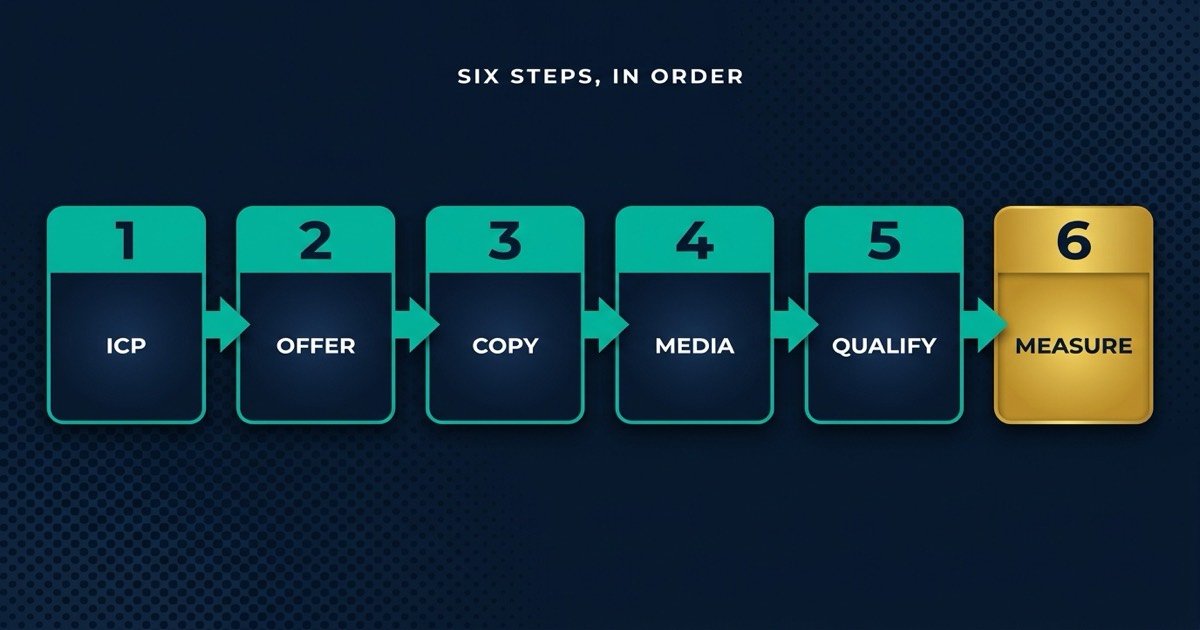
The sequence below is how to do B2B lead generation properly, and it is not a preference.
Each step only works if the one before it is right, which means a failure at step four is almost always a defect from step one that nobody caught.
I have spent more than $10M in managed ad spend across the Gulf and sat on over a thousand recorded sales calls.
The diagnosis is nearly always the same: the media was fine, the offer was weak.
So we start where the leverage is.
Step 1: pick the ICP and one clear outcome
Before you spend anything, answer two questions properly.
Who is this for, and what single outcome are you selling them?
For the first, I use FRED: Fears, Results, Expectations, Desires.
What keeps this buyer awake, what result they want, what they expect from a supplier, and what they actually want underneath the brief they would write you.
That last one is where the money is.
Buyers ask for a service and want a feeling: control, safety, the end of an argument with their board.
For the second, resist the urge to sell everything you do.
A campaign aimed at everyone converts for no one, and in a small market like the Gulf, breadth is expensive.
Get this wrong and every step after it is optimising a conversation with the wrong person.
Step 2: engineer the offer
This is roughly 80% of the result, and it is the step almost everyone skips because it is the only one that cannot be outsourced to a tool.
Nobody wants to "book a call" with a company they met ten seconds ago.
That is a request, not an offer.
So build something that solves a real slice of the problem on its own.
An audit.
A benchmark.
A calculator.
A diagnostic they could act on even if they never speak to you.
I engineer each one against the 5Ts.
Type. What kind of offer is it?
Transformation. What actually changes for them?
Trust. Why should they believe it?
Time. How fast does it work?
Ticket. What does it cost?
Underneath sits the value equation: raise the dream outcome and the perceived likelihood of getting it, lower the time and the effort.
The full method is in how I engineer offers.
A good offer also self-selects.
Someone who wants their pipeline scored cares about pipeline, which means the offer filters quality before your form asks a single question.
Step 3: write the copy
The offer decides whether they want it. The copy decides whether they notice.
I write on the Triple Hook: Premise, Stakes, Twist.
The premise is the claim that stops the scroll.
The stakes are what it costs to keep doing it the old way.
The twist is the part they did not expect, which is what earns the click.
Then the body does the work in order: callout, hook, problem, agitation, solution, offer, proof, urgency, call to action.
One discipline that matters more than any clever line: one idea per ad.
Copy that says three things says nothing, because the reader is deciding in under two seconds whether this is about them.
Step 4: buy the media
Simple structure. Big creative library. That is the entire modern answer.
One campaign, budget set at the campaign level. One or two broad ad sets. No stack of fifteen interest audiences.
The reason is Andromeda, Meta's delivery system, which shifted targeting from audiences to creative.
Meta's own data attributes roughly 56% of campaign performance to creative quality now.
So the old advice of running one or two ads is dead. Feed it 10 to 20 genuinely different creatives at once.
And I mean different concepts, not the same ad with a new headline.
A founder talking to camera, a text-on-screen problem callout, a before-and-after, a customer story, a contrarian take.
Iteration changes the hook.
Variation changes the idea.
The algorithm rewards variation, because that is what lets it find pockets of buyers you could never have targeted by hand.
The detail is in how I buy media.
Step 5: qualify with BANT in the funnel
This is the step that separates a lead list from a pipeline.
Qualification is not a phone call afterwards.
It is built into the funnel, so the filtering happens before anyone on your team spends an hour.
Every lead is scored against BANT, four checks that started life as an IBM sales framework and have survived because they are hard to argue with.
Budget. Can they pay?
Authority. Can they decide, or move the decision?
Need. Do they have the problem?
Timing. Are they ready now?
An instant form with two or three real qualifying questions gets me to roughly 60 to 80% qualified.
Not 100%, and I would distrust anyone claiming it.
The mechanics are in my BANT qualification guide.
Which funnel you use depends on the ticket.
Low-ticket or high-volume goes to an instant form with qualifiers, because friction costs you more than it filters.
High-ticket goes to a landing page with a booking step, because the extra friction raises intent and you want it.
And the rule I keep repeating because it keeps being ignored: a lead who fails only on Timing is not dead, they are early.
They go to nurture, not to the bin.
Step 6: measure and iterate
Here is what good looks like in my Gulf campaigns, so you have something to hold the system to.
- Cost per qualified lead: roughly 50 to 60 dollars.
- Cost per booked, sales-ready appointment: around 100 dollars.
- Return on ad spend: 9 to 11 times on the strongest accounts, 4 to 5 times on the weakest.
- Qualified share of inbound leads: roughly 60 to 80% through a well-built instant form.
Now the warning that goes with those numbers.
Cost per lead is the most over-watched metric in B2B, and the easiest one to improve dishonestly.
Loosen the offer, drop the qualifying questions, and your cost per lead falls immediately.
So does your revenue.
Judge B2B lead generation on cost per closed deal. Everything above it is a diagnostic, not a scoreboard.
When something is off, read the funnel backwards.
Bad close rate with good show-up means a qualification problem.
Bad show-up means a follow-up problem.
Expensive leads with good quality usually means a creative problem, not a targeting one.
Sequencing B2B lead generation when you cannot do everything
Almost nobody starts with all six steps resourced. So here is the order I would fix them in.
Offer first, always. In B2B lead generation it is free to change and it moves every downstream number.
Then qualification, because a mediocre offer with tight qualification wastes far less money than a strong offer with none.
Then creative volume. Then channel expansion. Then automation.
Everything on this page is buildable in-house, and I would rather you knew that than bought help you do not need.
The honest catch is that it takes four skills at once, and the system leaks at whichever one is missing while the team learns on live spend.
If you would rather have it built and run for you, that is what I do, and the whole machine is laid out on the system page.
For the wider context, start with the GCC lead generation playbook or the plain-English definition of B2B lead generation.
And if you want a second pair of eyes on where yours leaks, book a strategy call.