 Ahmed Elflal
What B2B lead generation actually means
B2B lead generation is how one business finds and qualifies other businesses that might buy from it.
That is the whole definition of B2B lead generation. Everything else is method.
The B2B part matters more than people assume. You are not selling to a person on impulse.
You are selling to an organisation.
Which means several people, a budget cycle, and an approval path.
So a B2B lead is rarely one individual saying yes.
It is one individual agreeing to start a conversation that other people will eventually join.
Here is where most definitions stop, and where most companies go wrong.
They treat lead generation as traffic collection.
Get attention, capture contact details, hand the list to sales, call it pipeline.
That produces a database, not a pipeline.
The missing half is qualification, and it is the half I would keep if I had to throw one away.
Lead generation, demand generation, and sales
These three get used interchangeably, and the confusion costs real money. The boundaries are actually clean.
Demand generation creates awareness of a problem in people who are not yet looking.
It warms a market.
It does not ask for anything.
Lead generation captures and qualifies the people who are ready to act. It asks for something specific: an identity, a conversation, a meeting.
Sales takes those qualified conversations and closes them.
There is a well-known finding from the Ehrenberg-Bass Institute, often called the 95:5 rule: at any moment roughly 5% of your potential buyers are actually in-market, and the other 95% will buy eventually, just not now.
Demand generation is what you do for the 95%.
Lead generation is what you do with the 5%.
Confusing them is why so many campaigns produce applause and no meetings.
I sell lead generation.
Demand generation is the awareness layer that feeds it, never the thing I am selling on its own.
The types of B2B leads, in plain words
You will meet two sets of jargon. Both are simpler than they sound.
MQL and SQL. A marketing qualified lead is someone marketing thinks is worth a sales conversation.
A sales qualified lead is someone sales has agreed is worth their time.
The distance between those two numbers is the most honest metric in a B2B funnel.
Pass a hundred MQLs, get twelve accepted, and your problem is not traffic.
It is the filter.
Inbound and outbound. Inbound means they came to you: a search, a referral, an ad they chose to click.
Intent is high, volume is capped by how many people are looking this month.
Outbound means you went to them: a call, a message, an email to someone who never raised a hand.
Volume is controllable, intent starts at zero.
Most companies need both, and the honest reason is arithmetic. Inbound alone cannot grow faster than your category's search demand.
How B2B lead generation actually works: the four layers
When someone asks me to explain lead generation as a system rather than a concept, this is what I draw.
Four layers, in order, because each one only works if the previous one is right.
The full version is in my GCC lead generation playbook.
One: the offer. This is roughly 80% of the outcome and the part almost everyone skips.
Nobody wants to "book a call" with a company they met ten seconds ago.
So the offer has to solve a real slice of the problem by itself: an audit, a benchmark, a calculator, a diagnostic.
I engineer each one against the 5Ts: Type, Transformation, Trust, Time, and Ticket.
What it is, what changes, why they should believe it, how fast, and what it costs.
That method is in how I engineer offers.
Two: the copy. Written on the Triple Hook: Premise, Stakes, Twist.
The premise stops the scroll.
The stakes make inaction expensive.
The twist is the part they did not already believe.
Three: the media. Simple structure, large creative library.
One campaign, budget at campaign level, one or two broad ad sets.
The reason it stays simple is Andromeda, Meta's delivery system, which moved targeting from audiences to creative.
Meta's own data attributes roughly 56% of performance to creative quality now.
So the old advice of running two ads is dead.
Ten to twenty genuinely different concepts run at once, which is covered in how I buy media.
Four: the funnel. Where a lead becomes pipeline, and where the word "qualified" earns its meaning.
What "qualified" actually means
Qualification is not a phone call after the fact. It is built into the funnel itself.
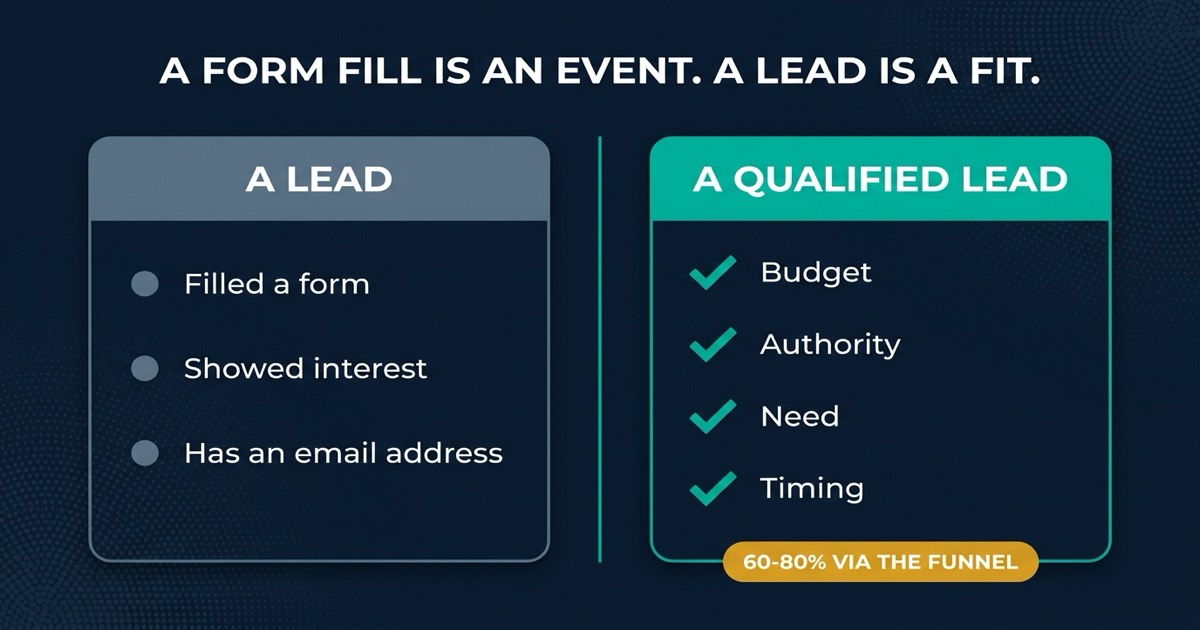
Every lead gets scored against BANT, which is four checks.
Budget. Can they actually pay for this?
Authority. Can they decide, or move the decision?
Need. Do they have the problem you solve?
Timing. Are they ready now, or someday?
BANT started as an IBM sales framework and it has survived because it is hard to argue with.
Those four questions are genuinely what separates a buyer from a browser.
Built properly, an instant form with real qualifying questions gets me to roughly 60 to 80% qualified leads.
Not 100%, and anyone promising 100% is selling something.
The mechanics are in my BANT qualification guide.
One nuance that matters more than any other here.
A lead who fails only on Timing is not a dead lead. They are an early lead.
They have the budget, the authority, and the need.
They just do not want it this quarter.
Deleting that lead throws away money you already spent to acquire them, which is exactly what a nurture layer exists to prevent.
A concrete example
Abstractions are easy to agree with and hard to use, so here is the shape of a real one.
A B2B services company in the Gulf sells a considered, high-value engagement.
Cold "book a call" ads produce almost nothing, because nobody books a call with a stranger.
So the offer becomes a diagnostic: a scored audit of the thing the buyer already worries about.
That self-selects.
Someone who wants their pipeline scored cares about pipeline.
The ads run broad with a wide creative library, because the creative now does the targeting.
The form asks two or three qualifying questions rather than just harvesting an email.
What reaches the sales team is not everyone who clicked.
It is the subset with budget, authority, need, and a real timeline, with their answers attached so the first conversation starts halfway through.
The unqualified do not get discarded either.
They go into follow-up until their timing changes, which in the Gulf usually means WhatsApp rather than email, because that is where decision-makers actually read.
That is B2B lead generation as a system rather than a definition.
The one thing to take away about B2B lead generation
If you remember a single line from this page, make it this one.
Lead generation is not about getting more leads.
It is about getting fewer, better ones, and knowing which is which before your sales team spends an hour finding out.
Volume is easy to buy.
Qualification is the part of B2B lead generation that decides whether it turns into revenue.
If you want to see what that looks like built and running, it is on the system page, and the version I run for clients is on my B2B lead generation method.
If you would rather just talk about your own pipeline, book a strategy call.