 Ahmed Elflal
Why SaaS lead generation leaks in the Gulf
SaaS lead generation has a measurement problem disguised as a marketing problem.
Signups are easy to count.
Signups feel like progress.
Signups are not pipeline.
Every GCC SaaS founder I have sat with can tell me their signup number.
Far fewer can tell me what share of those accounts had a budget, a decision-maker, and a reason to switch this quarter.
That gap is where the money goes.
You pay to acquire a thousand accounts, your reps chase the loudest hundred, and nobody notices that the qualification step was never built, only assumed.
I have spent more than $10M in managed ad spend across the Gulf and sat on over a thousand recorded sales calls.
The SaaS version of the problem is remarkably consistent: the traffic is fine, the filter is missing.
There is a second, quieter issue specific to this region.
What makes SaaS lead generation different here
Most SaaS growth playbooks are written for markets with enormous search volume and self-serve buying culture.
The Gulf has neither, yet.
Search volume is thin. Your category might get a few hundred searches a month across the whole region.
So an inbound-only strategy caps out fast, and the growth has to come from creating demand rather than harvesting it.
Buying is more relationship-led than self-serve. Even for products that could be bought with a card, GCC buyers frequently want a conversation first.
That is not friction to be optimised away, it is the market telling you the motion.
The buying committee is larger than the signup. The person who starts your trial is often not the person who signs.
They are your internal champion, and your job is to arm them for a conversation you will not be in.
Follow-up happens on WhatsApp. Gulf decision-makers run their day from their phone.
A trial-nurture sequence built purely on email underperforms here against one that meets them where they read.
All of which changes the offer, not the machine.
My SaaS lead generation system, layer by layer
Four layers, in order, because each one only works if the one before it is right.
The full version is in my GCC lead generation playbook.
Layer one: the offer. For SaaS this is where most campaigns quietly fail.
"Start your free trial" is not an offer.
It is a request for work: the buyer has to set it up, learn it, and prove value to themselves, all before they trust you.
So I build an offer that delivers something before the product does.
A benchmark against their peers.
An audit of the process the software replaces.
A calculator that quantifies the problem in their own numbers.
That reframes the trial from a chore into a next step, and it self-selects: someone who wants their process audited actually has the process.
I engineer each offer against the 5Ts, which is set out in how I engineer offers.
Layer two: the copy. Written on the Triple Hook: Premise, Stakes, Twist.
For SaaS the discipline is to sell the outcome, not the feature list.
Nobody buys a dashboard.
They buy the end of a spreadsheet they hate.
Layer three: the media. Simple structure, deep creative library.
One campaign, budget at campaign level, one or two broad ad sets.
That is because of Andromeda, Meta's delivery system, which moved targeting from audiences to creative, with Meta's own data attributing roughly 56% of performance to creative quality.
So 10 to 20 genuinely different concepts run at once, not one ad with variations.
Given how thin regional search volume is, this creative-led reach is what makes SaaS growth possible here at all.
The detail is in how I buy media.
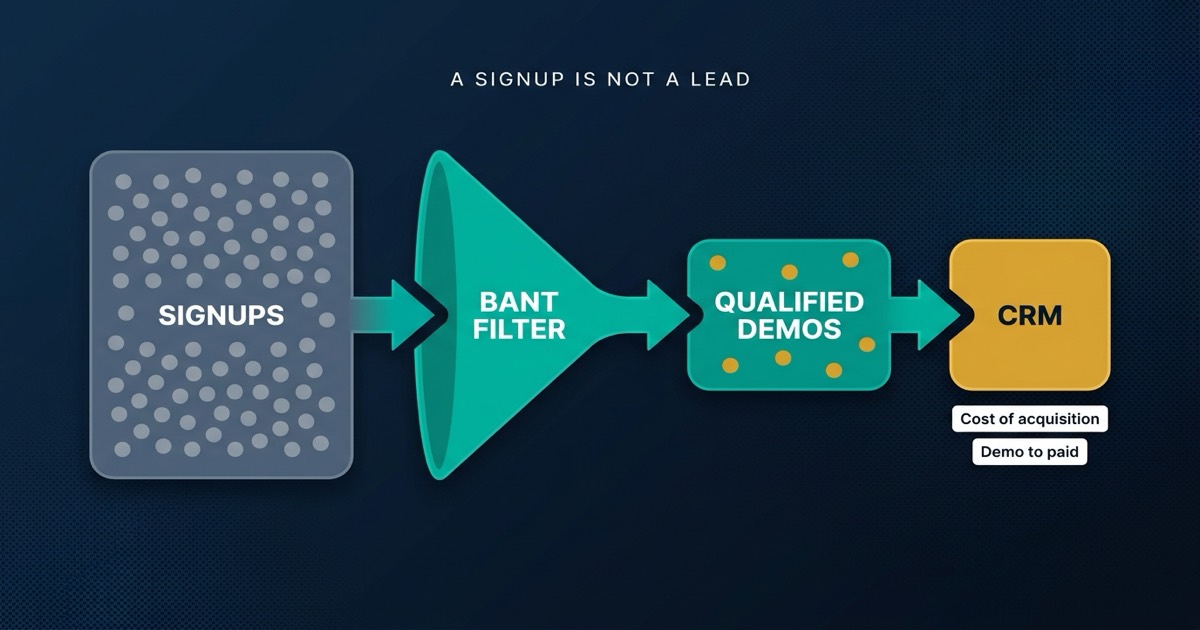
Layer four: the funnel. Where a signup becomes a qualified demo.
How SaaS lead generation qualifies demos before your reps spend time
Every lead gets scored against BANT: Budget, Authority, Need, Timing.
Can they pay, can they decide, do they have the problem, are they ready now.
Built properly, an instant form with real qualifying questions gets me to roughly 60 to 80% qualified.
The mechanics are in my BANT qualification guide.
SaaS bends two of those four letters, and it is worth being precise about how.
Authority is usually split. Your trial starter is rarely your signer.
Treating them as unqualified is a mistake I see constantly.
They are qualified, they are just not the whole committee, so every asset is built to be forwarded upward.
Need has to be specific. "Interested in the category" is not a need.
"Currently doing this in spreadsheets and it broke last quarter" is.
The qualifying question should surface the trigger event, not the curiosity.
And the rule that applies everywhere: a lead who fails only on Timing is early, not dead.
In SaaS that is especially true, because renewal dates and budget cycles create genuinely predictable windows.
Nurture until theirs arrives.
Measuring SaaS lead generation like a business, not a campaign
Here is what good looks like in my Gulf campaigns, as a benchmark rather than a promise.
- Cost per qualified lead: roughly 50 to 60 dollars.
- Cost per booked, sales-ready demo: around 100 dollars.
- Return on ad spend: 9 to 11 times on the strongest accounts, 4 to 5 times on the weakest.
- Qualified share of inbound leads: roughly 60 to 80% through a well-built instant form.
For SaaS, though, those are leading indicators, not the scoreboard.
The numbers that decide whether this worked are cost of acquisition against contract value, demo-to-paid conversion, and how long the payback takes.
A 100 dollar demo is cheap against an annual enterprise contract and ruinous against a low monthly plan.
So the routing matters as much as the acquisition.
Every lead lands in your CRM with its qualification answers attached, tagged by source, so you can trace a paying account back to the ad that started it.
Without that thread, you end up optimising for cheap signups, which is the single most reliable way to grow a SaaS business into unprofitability.
What SaaS lead generation gets you, and who it is not for
What I build and hand over: the offer, the creative library, the media account structure, the qualification funnel, the CRM routing and automation, and reporting that ties revenue back to source.
You own all of it. Leads, data, accounts.
This fits if you sell B2B SaaS into the Gulf with a contract value that justifies paid acquisition, and someone can take a demo within a day of a lead raising their hand.
It is not for consumer apps.
The B2B-only rule is not snobbery, it is that the qualification logic on this page assumes a buying committee and a budget line, and neither exists in a consumer purchase.
It also will not fix weak retention.
If accounts churn at three months, more of them arriving faster just makes the leak louder.
That is a product conversation before it is a SaaS lead generation one, and I would rather say so on the first call.
If you want the whole machine in one view, it is on the system page.
The core method is my B2B lead generation method, and the wider tactic menu is in 15 lead generation strategies for the GCC.
If your signup chart looks healthy and your pipeline does not, book a strategy call and we will find where the two stopped agreeing.