 Ahmed Elflal
Here is the uncomfortable truth that reshapes how you should spend every marketing dollar.
At any given moment, almost nobody you want to reach is ready to buy.
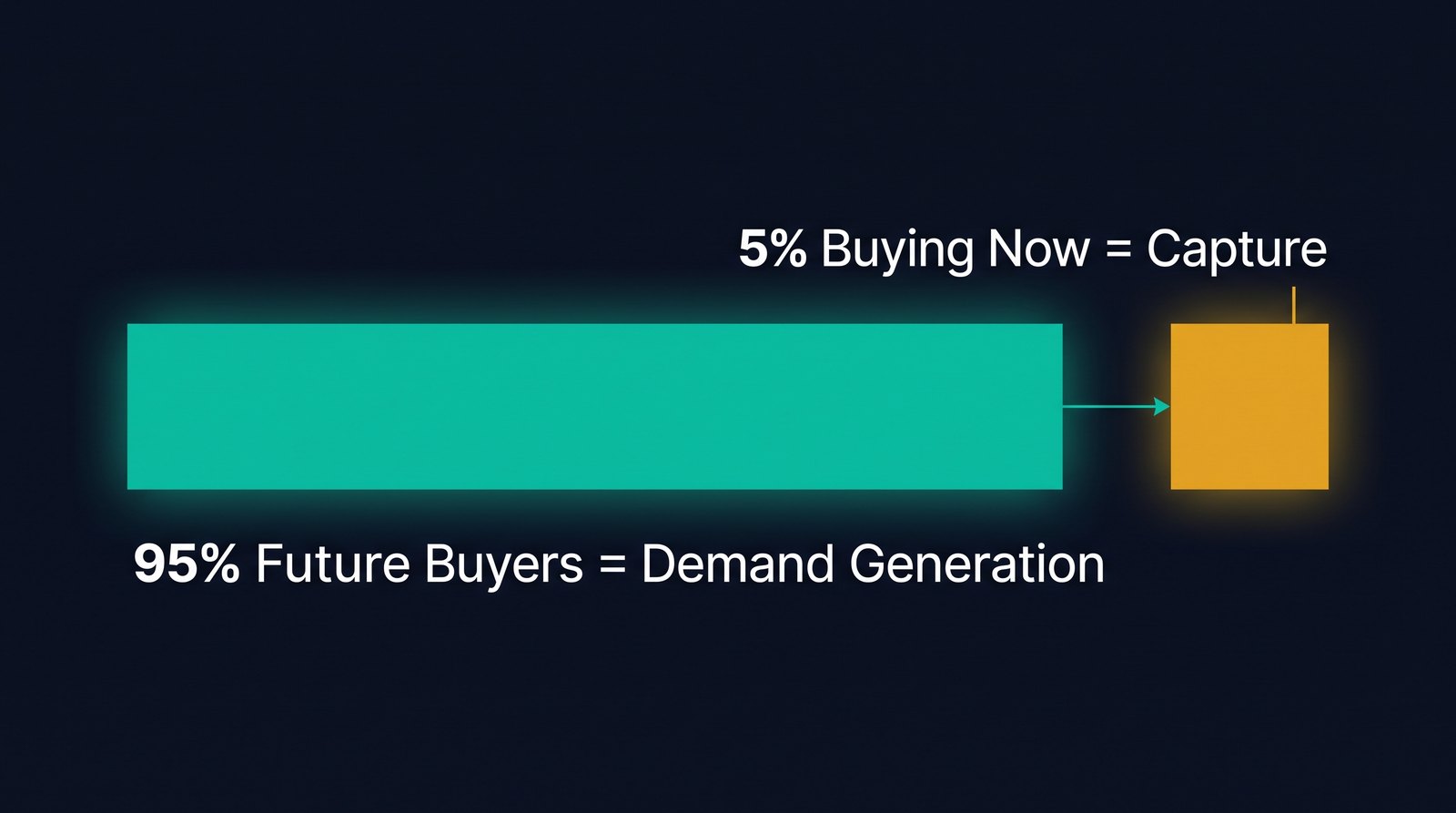
Research from the Ehrenberg-Bass Institute, the marketing-science group behind a lot of what LinkedIn now teaches, puts a number on it. In a typical quarter, only about 5% of your potential buyers are in-market. The other 95% are not shopping at all.
They call it the 95-5 rule.
Now look at how most B2B companies spend.
Everything goes at the 5%. Search ads, retargeting, hard outreach. All fighting over the tiny slice that is buying today.
And nothing goes at the 95% who will buy next quarter, next year, the year after.
That is what demand gen fixes. Let me show you what it is, and how I run it in the Gulf.
What demand generation actually means
Demand generation is the work of creating demand among people who are not looking for you yet.
Read that again, because it is the whole idea.
You are not capturing demand that exists. You are creating it where there was none.
You do it by becoming familiar and trusted long before the buyer has a need.
So that on the day the need shows up, you are the first name they think of, and the only one they already trust.
That is the opposite of waiting for someone to search "best supplier near me" and bidding to be the answer.
By then the race is expensive and crowded. Demand generation is how you stop racing.
Demand generation vs lead generation, in plain terms
People use these two words as if they mean the same thing. They do not.
Lead generation captures the 5% who are ready now.
It asks for the hand-raise, the form fill, the booked call. It is the harvest.
Demand generation builds the 95% who are not ready yet.
It plants. It teaches, shows, and earns trust so that future buyers arrive already warm. It is the farming.
You need both. A farm that only ever harvests and never plants runs out of crop.
The mistake is spending 100% on the harvest because it is the only part you can measure this week.
A sensible split for most B2B teams is closer to 70% on building the 95% and 30% on capturing the 5%.
If you want the capture side in detail, that is what lead qualification and the delivery systems cover. This piece is about the planting.
The Omni Campaign: how I run demand generation as one machine
Here is where most demand generation falls apart. It becomes "post more content" with no structure, no owner, and no link to revenue.
So it gets cut the first time budget is tight, because nobody can prove it did anything.
I run it differently, inside a structure I call the Omni Campaign. Three ideas hold it together.
Omnipresence. You show up everywhere your buyer already spends attention, so often that you feel like the obvious choice. Not one channel. The places they actually are.
One objective. The whole campaign points at a single business goal, not a scatter of vanity metrics. Pipeline, not likes.
One owner. A single person owns the full funnel end to end, from the first piece of content to the booked call. No hand-offs where leads leak between teams.
That is the spine. Underneath it runs a simple seven-step motion that turns the idea into a repeatable campaign.
The seven-step motion
One, take a brief in plain business language: the goal, the offer, the audience, the deadline.
Two, turn that brief into a strategy: the funnel stages, the channels, the message, the budget, the numbers you will judge it by.
Three, form a small pod: an owner, a media buyer, someone on copy and design, someone on the automation.
Four, create the content: the ads, the pages, the email and message sequences, the proof.
Five, review it in two passes, pod then final, so nothing sloppy ships.
Six, launch, and test a real lead through the whole funnel before you trust it.
Seven, analyse and bank the learning: what worked, where leads dropped, and which assets become reusable templates for next time.
That seventh step is what compounds. Every campaign leaves the next one stronger. I break the full motion down in the Omni Campaign playbook.
What demand generation looks like day to day in the Gulf
Theory is cheap. Here is the shape of it on the ground.
You publish content that teaches your buyer something useful, in the language they think in, often both Arabic and English.
You run reach and video campaigns that build familiarity, not just lead forms.
You stay visible to the people who engaged but did not act, so you are still there when their timing changes.
And here is the part that changed recently, so do not run on old advice.
Meta's ad system went through a major shift, the Andromeda update, which moved delivery from picking audiences to reading creative. In plain terms, the algorithm now decides who sees your ad based mostly on the ad itself, not the targeting box.
What that means for you: variety of creative is now the lever. The old habit of running one or two ads is dead. You feed the system 10 to 20 genuinely different angles, hooks, and formats, and let it find the buyers.
For this work, that is good news. The more real, varied, useful creative you make, the better the machine builds your 95%. Vague creative attracts vague interest, so the message has to be sharp. The way I write ads is built for exactly this.
The content that actually builds the 95%
Demand gen is not "post more." It is publishing things that make a future buyer trust you before they need you.
Three kinds of content do that work.
Teaching content shows the buyer how to think about their problem. You give away the how, freely, because the people who could never do it themselves are exactly the ones who will hire you. Generosity is a trust machine.
Proof content shows you have done this before. Results, before-and-afters, the receipts. In B2B, nobody buys a promise they cannot verify.
Point-of-view content shows what you believe and who you are for. A clear stance repels the wrong buyer and magnetises the right one. Bland content builds nothing.
Notice none of these ask for the sale. They build the relationship that makes the sale easy later.
Where to run it in the Gulf
The channel is not the strategy, but the channels here have their own shape.
Meta, meaning Facebook and Instagram, is where you build broad familiarity with reach and video campaigns, not just lead forms. This is the top of the machine, and the recent creative-led shift makes it stronger for the brand-building job.
LinkedIn is where the professional buyer lives, and where teaching and point-of-view content earns authority with decision-makers.
Short video, on Instagram and TikTok, is the fastest way to build a face and a voice the buyer recognises. People trust a person before they trust a logo.
And quietly underneath it all sits WhatsApp, where the relationship gets personal once someone raises a hand. In this region a warm WhatsApp thread does more than a dozen emails.
The 70/30 split, with a real example
Here is the split that keeps demand generation honest: roughly 70% of effort building the 95%, 30% capturing the 5%.
Picture a 10,000 dollar monthly budget. About 7,000 goes to reach, video, and content that warms future buyers. About 3,000 goes to the lead forms, the appointment funnel, and the retargeting that converts buyers who are ready now.
Most companies invert this. They put 9,000 on capture and 1,000 on building, then wonder why their costs climb every quarter. They are draining a well they never refill.
The 70 builds the pond. The 30 catches the fish. Stop refilling the pond and the fishing gets worse every month, no matter how good your hook is.
How demand generation hands off to lead generation
The two halves are not separate campaigns. They are one motion.
Demand generation warms a stranger into someone who knows and trusts you. Lead generation catches that warmed person at the moment their need turns on, and qualification checks they can buy.
The hand-off is the retargeting layer: the people who watched your videos, read your posts, and engaged but did not act. They are your warmest future buyers. When you run a capture campaign, you run it to them first, because they convert far cheaper than a cold stranger ever will.
That is why demand gen makes your lead generation cheaper. You are no longer buying cold attention every time. You are harvesting a crop you already planted.
How to measure demand generation without fooling yourself
The honest objection to all of this: "how do I know it is working?"
You do not measure it by today's form fills. That is measuring the farm by this morning's harvest.
You watch leading signs. Are more people arriving already knowing who you are. Is your branded search rising. Are sales calls getting easier because the prospect showed up warm. Is the share of your pipeline that came in pre-sold growing over time.
Then you tie it to the one number that pays the bills: pipeline created, and revenue closed.
Give it a single owner, one objective, and a quarter of patience, and the 95% stops being a cost you cannot justify.
It becomes the reason next year's selling is easy.