 Ahmed Elflal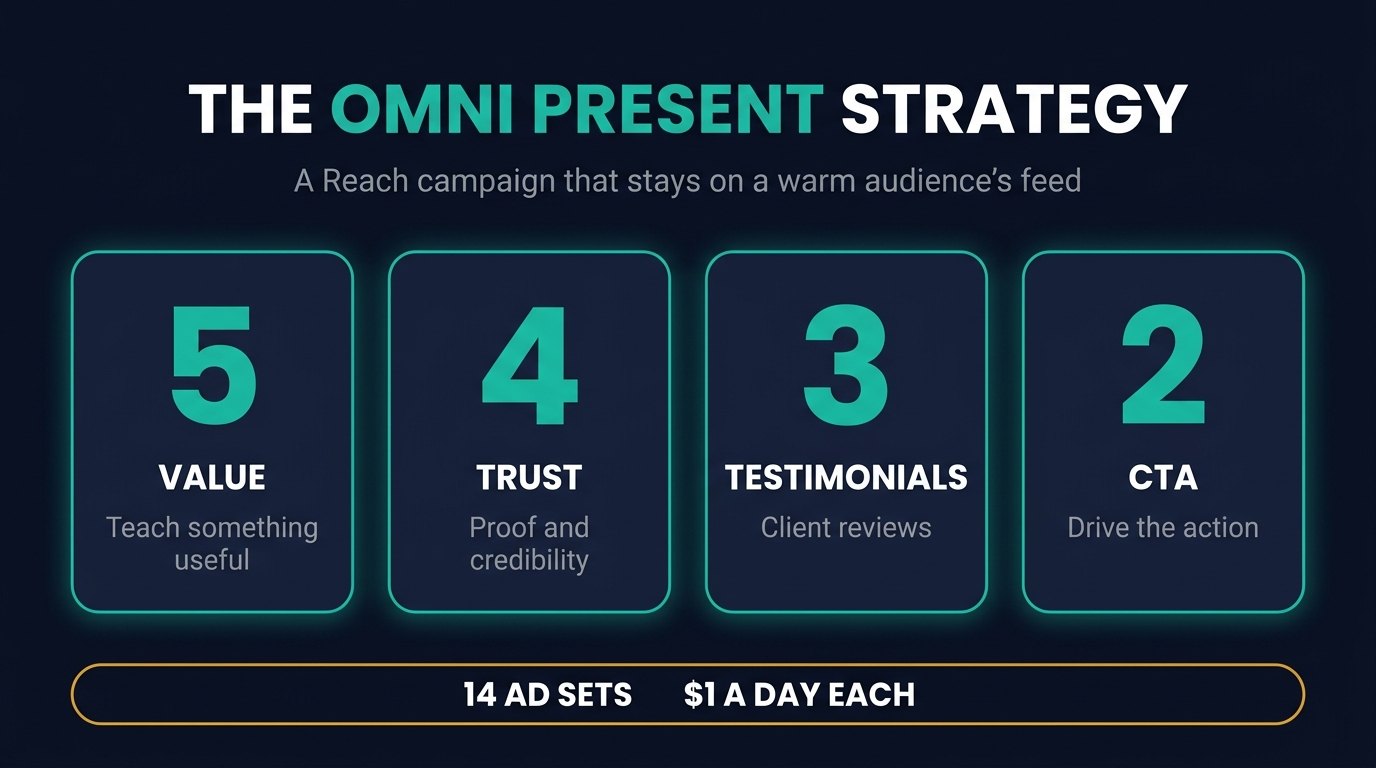
Most retargeting is one ad.
"Book a call," shown to the same people until they are sick of the sight of you.
The Omni Present Strategy is the opposite.
Instead of one ad asking for the sale, you surround a warm audience with a steady stream of valuable content, so by the time you do ask, they already know you, trust you, and want it.
It quietly does three jobs at once. It builds the brand. It raises lead quality. And it lowers cost per lead.
It only runs to a warm audience
This is not for cold strangers. It is for people who already had a moment with you.
You build a custom audience, usually 100,000 to 250,000 people, from the warm signals you already have:
- People who visited your website.
- People who watched more than half of one of your videos.
- People who submitted or opened a lead form.
- People who visited your page or profile.
- People who engaged with an ad or a post (a comment, a share, a reaction).
These people are not strangers. They are the warm pool, and warm converts cheaper than cold.
The objective is Reach, not conversions
Here is the part that feels wrong to most media buyers.
You do not optimize for conversions. You run a Reach campaign.
Because the job here is presence, not the immediate click. You are buying your way onto their feed, again and again, with something worth seeing.
Then you cap the frequency: each ad set is set to roughly one impression per person every 7 days. Stacked across the ad sets, that lands at about 2 ads a day.
Enough to stay present. Not enough to become the brand they mute.
14 ad sets at $1 a day
The structure is deliberately cheap and broad.
14 ad sets. $1 a day each. Roughly $14 a day to blanket a warm audience of up to a quarter million people.
Each ad set carries one piece of content. Many small, steady bets instead of one big ad, so you are everywhere at once without spending like it.
Four content buckets, and the ratio matters
The 14 ad sets are not random. They split across four buckets, and the split is the point: you give far more than you ask.
Value (5 ad sets). Genuinely useful content. How-to videos, industry tips, educational articles. You teach, with no pitch.
Trust (4 ad sets). Proof you can deliver. Accreditations, your service steps, company achievements, client stories, your USPs.
Testimonials (3 ad sets). Let results speak. Video testimonials, written reviews, case studies, Google reviews.
Call to Action (2 ad sets). The only place you ask. A free consultation, a guide, a clear next step.
Nine of the fourteen are pure value and trust. Only two ask for anything. That ratio is why the audience never feels sold to.
Use varied formats
Same audience, same buckets, different shapes, so the content never goes stale.
Short videos under 60 seconds for the key messages. Articles and blog links. Carousels to walk through several things at once. Clean images with a sharp caption.
Variety is what keeps you present without becoming wallpaper.
Why it does three jobs at once
One simple structure, three outcomes.
It builds the brand. Showing up consistently with value is how a name becomes familiar, and familiar is how trust starts.
It raises lead quality. A lead who has watched you teach, prove, and get reviewed for weeks arrives half-sold and self-qualified, not cold and skeptical.
It lowers cost per lead. A warm, pre-sold audience converts at a fraction of the cost of a cold one, and Reach at $1 a day is cheap presence. So when the CTA ad sets do their job, the leads are cheaper.
How to set it up
The motion is simple:
- Build the warm custom audience from your website, video, lead, and engagement signals.
- Create a Reach campaign with 14 ad sets at $1 a day each.
- Split them across the buckets: 5 Value, 4 Trust, 3 Testimonials, 2 CTA.
- Cap the frequency so each person sees roughly 2 ads a day.
- Rotate formats, and refresh the creative when a piece starts to fatigue.
Keep it always on, and the warm pool stays warm, while the cost of every booked call quietly drops.