 Ahmed Elflal
Most B2B marketing in the Gulf fails for the same reason.
It is a pile of tactics, not a machine.
A few ads here. An email tool over there. A landing page someone built last year. A salesperson chasing whoever happens to call.
Each piece works in isolation and the whole thing leaks at every join.
Leads fall between the ad and the page, between the form and the follow-up, between marketing and sales.
You cannot fix that by buying more traffic. More traffic into a leaky machine just leaks faster.
So before any channel talk, let me give you the order that actually matters.
The order that decides everything
Get these in the wrong sequence and nothing downstream saves you. In order:
Offer before traffic. The strength of what you sell matters more than how many people see it. A strong offer to a small audience beats a weak offer to a huge one. Fix the offer first, always.
Positioning before persuasion. Where you stand in the buyer's mind, and who you are clearly for, does more work than any clever line. If they cannot place you, no copy rescues you.
Psychology before tactics. Understanding the fear and the desire driving the buyer beats any channel trick. Tactics are levers; psychology is the hand on the lever.
Systems before effort. A machine that runs without you beats heroics that need you every day. Effort does not scale. Systems do.
Notice that traffic, the thing most people start with, comes dead last.
That is not an accident. Traffic is the easiest part to buy and the least important to get right first.
B2B marketing as one chain, not a funnel of strangers
Picture the whole thing as a single chain. Each link feeds the next, and the chain is only as strong as its weakest join.
Traffic brings the right people in.
Capture turns a click into a contact.
Qualification checks they can actually buy.
Routing gets the right lead to the right person fast.
Nurture keeps the not-yet-ready warm.
Booking puts a real call on the calendar.
Follow-up reaches them before they cool.
Reporting tells you which link is leaking.
Iteration fixes that link, then the next.
That is B2B marketing. Not a list of channels. A chain with nine links.
When a Gulf company tells me their marketing is not working, I do not ask which channel.
I ask which link is leaking. It is almost never the one they think.
Usually they are pouring budget into traffic while the capture and follow-up links are wide open. I lay this out fully in the 4-layer lead gen system.
Build for the 95%, not just the 5%
Here is the strategic trap almost every B2B team in the region walks into.
In any given quarter, only about 5% of your potential buyers are ready to buy. The other 95% are not in the market yet. That is the 95-5 rule, from the Ehrenberg-Bass Institute, the research group behind much of what LinkedIn now teaches.
Most companies aim everything at that 5%. Search ads, hard outreach, bottom-funnel pushes, all fighting over the same small slice.
So your marketing has two jobs, not one.
Capture the 5% who are ready now, through lead generation and a tight funnel.
And build the 95% who will be ready later, through demand generation, so they arrive already trusting you. I cover that side in full in the demand generation playbook.
Skip the 95% and you are stuck forever bidding against everyone else for the same tiny crowd. That is why your costs only ever go up.
What makes B2B marketing in the GCC different
The chain is universal. How you run it in the Gulf is not. Four things change here.
WhatsApp is the spine, not a nice-to-have. In this region a WhatsApp message is opened in minutes and an email often is not. So your follow-up, your reminders, and a lot of your selling run on WhatsApp. Treat a WhatsApp reply as a primary conversion, not a soft one.
Two languages, two mindsets. Arabic and English are not just a translation job. The buyer thinks differently in each. The strongest campaigns speak to the right one in the right register, not a literal swap of words.
Trust and relationship lead. Gulf B2B is relationship-driven. Cold and transactional underperforms. Warm, credible, and consistent wins, which is exactly why demand generation pays off here.
The platform reality of 2026. Meta's delivery system shifted with its Andromeda update, from choosing audiences to reading your creative. In plain terms, the ad itself now decides who sees it. So you feed the system 10 to 20 genuinely different creatives instead of one or two, and let it find your buyers. The way you ran ads in 2024 quietly stopped working. My media buying approach is built for the new rules.
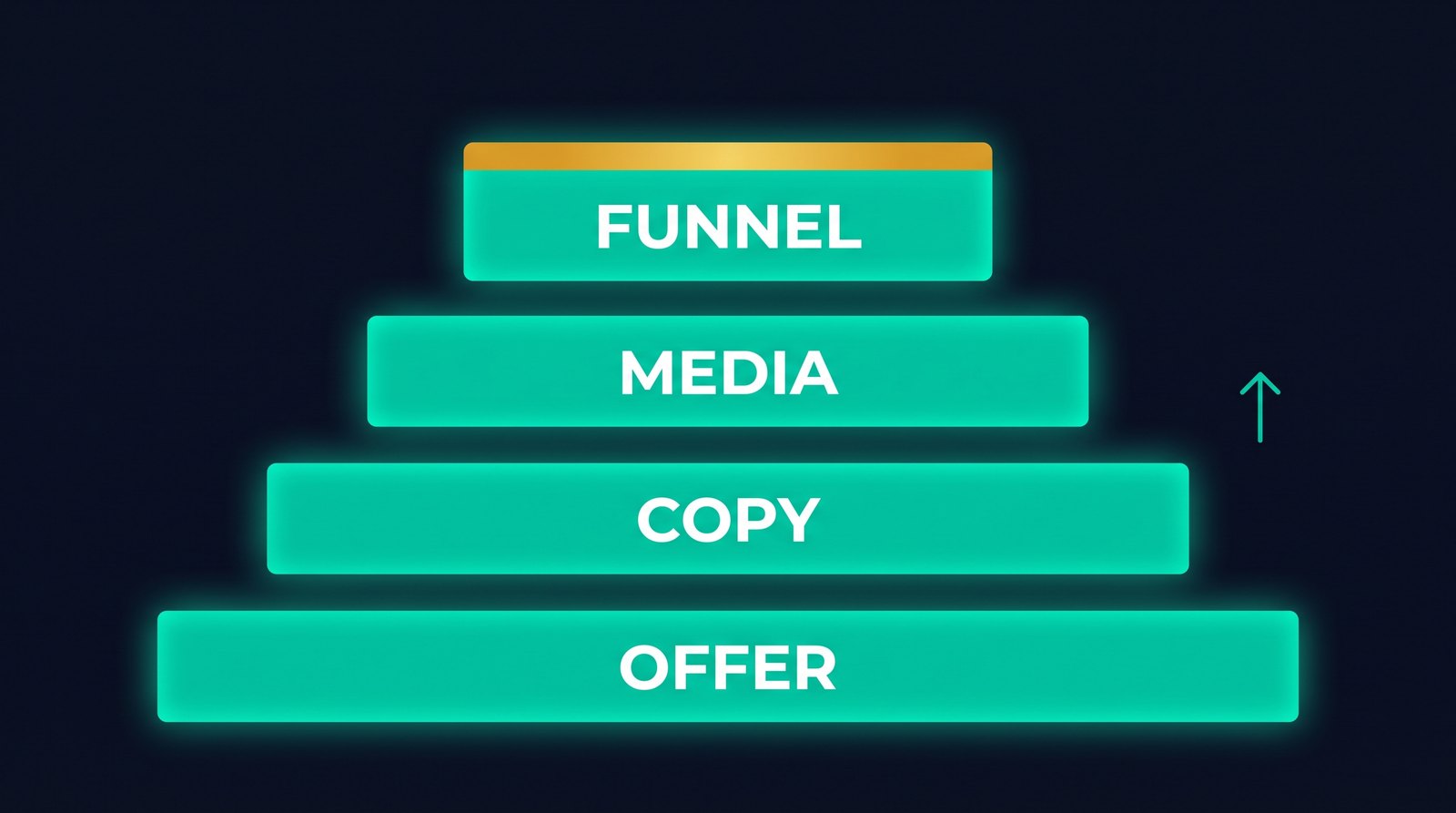
The four layers underneath the chain
The nine-link chain is what the lead travels through. Underneath it sit four layers that decide whether the chain holds. Build them in this order.
Offer. What you sell and how irresistible it is. The deepest lever, and the one most people ignore because it is hard. A great offer makes mediocre everything-else work. A weak offer makes great everything-else fail.
Copy. The words that carry the offer. The hook that stops the scroll, the message that makes them feel understood, the line that makes them act. Copy is salesmanship in print.
Media. How you put it in front of the right people and at what cost. This is the paid engine, and in 2026 it runs on creative variety, not clever targeting.
Funnel. The path from click to booked call: the page, the form, the qualification, the follow-up. The plumbing that stops leads leaking.
Offer, copy, media, funnel. When a campaign underperforms, the broken layer is almost always higher up than people look. They blame the media when the offer was the problem all along.
The channels, and the job each one does
A channel is a tool, not a strategy. Here is the job each does in a Gulf B2B machine.
Meta, meaning Facebook and Instagram, is the workhorse for both building the 95% with reach and video, and capturing the 5% with lead forms and the appointment funnel. Broad and cost-effective.
Google Ads catches people at the exact moment they search, which is pure bottom-funnel capture of the ready-now 5%. High intent, higher cost per click.
LinkedIn reaches the professional decision-maker directly, which is powerful for authority content and for narrow, high-value targeting.
Email and WhatsApp are the nurture and follow-up layer, where you keep the not-yet-ready warm and carry the ready to a call. In this region, WhatsApp does most of that work.
The mistake is picking a channel first. You pick the job first, then the channel that does it.
Give the whole machine one owner
Here is the structural fix that quietly solves most leaks: one person owns the entire chain, end to end.
Not marketing owning the top and sales owning the bottom, with leads dying in the gap between them. One owner who watches the lead from the first ad to the closed deal, and who is judged on pipeline, not on their slice.
Around that owner you build a small pod for a campaign: someone on media, someone on copy and design, someone on the automation and CRM. The pod ships the campaign, then the owner watches every link and fixes the one that leaks.
This is the core of how I run campaigns. Scattered ownership is why scattered tactics leak. One owner, one chain, one number.
The numbers a healthy B2B machine hits
So you have something to aim at, here are the benchmarks I run toward on a well-built Gulf campaign.
A cost per lead, meaning what you pay for one qualified contact, around 50 to 60 dollars.
A cost per booked appointment near 100 dollars.
And a return on ad spend, meaning revenue back for every dollar in, in the range of 9 to 11 times.
Those are not guarantees. They are what the machine produces when every link in the chain is sound and one owner is watching all of it.
If your numbers are far off these, the answer is almost never "spend more on ads."
It is to find the leaking link and fix it.
Where to start
Do not start with a channel. Start with the order.
Get the offer right. Sharpen the positioning. Understand the buyer. Build the system. Then, and only then, turn on the traffic.
Give the whole chain one owner and one metric that matters, pipeline.
That single shift, from a pile of tactics to one owned machine, is what separates the Gulf B2B companies that grow from the ones that just spend.