 Ahmed Elflal
Why generic lead generation in Abu Dhabi underperforms
Most agencies treat lead generation in Abu Dhabi as Dubai with more parking.
Same creative.
Same offer.
Same "book a call now" urgency that works fine on a Dubai founder who decides on Tuesday and signs on Thursday.
Then the campaign lands in front of an Abu Dhabi buyer, and nothing happens.
Not because the ad was bad. Because the ad assumed a buying process that does not exist here.
Dubai rewards speed. Lead generation in Abu Dhabi rewards something else.
Abu Dhabi rewards credibility, and it verifies that credibility through a process that has paperwork attached.
I have spent more than $10M in managed ad spend across the UAE and the Gulf, and the emirate split is one of the most consistent patterns I see.
The same campaign, run identically in both markets, produces two completely different conversion shapes.
So the question is not how to get more leads in Abu Dhabi.
It is what the buyer here actually needs before they can say yes.
What is genuinely different about B2B lead generation in Abu Dhabi
Four things change the play. The first one is the one nobody optimises for.
Procurement is the real decision-maker. In Abu Dhabi, an enormous share of B2B spend runs through formal supplier evaluation, and that evaluation has a scoring sheet.
The clearest example is In-Country Value.
Abu Dhabi government entities and the ADNOC supply chain require suppliers to submit an ICV certificate, and the ICV score carries roughly 40% of the financial evaluation.
No certificate means a score of zero, which in practice means you are out before anyone reads your proposal.
Think about what that does to your marketing.
Your buyer is not asking "is this compelling." They are asking "can I defend this choice on a scoresheet."
So the offer has to arm them.
Documentation, credentials, references, and a clear commercial structure beat clever urgency every time.
Relationships gate the shortlist. Cold outreach into Abu Dhabi rarely produces a first meeting with a serious account.
What it produces is a name someone recognises three months later when a requirement appears.
That is not failure.
That is the mechanism.
It just means you have to fund presence for longer than one campaign cycle before you judge it.
The buyer base is concentrated and government-adjacent. Energy, infrastructure, sovereign investment vehicles, real-estate developers, and the professional services orbiting all of them.
Fewer accounts, larger deals, longer cycles, and a much smaller world in which your reputation travels fast in both directions.
The working week is Monday to Friday. The UAE moved its federal week in 2022, so Abu Dhabi government-linked entities run Monday through Friday, with Sharjah on a Monday to Thursday week and the private sector setting its own.
If your campaign scheduling still assumes an old Sunday to Thursday Gulf week, you are pushing budget into days your buyer is not working.
All of which changes how the system gets tuned, but not what the system is.
My lead generation system in Abu Dhabi, layer by layer
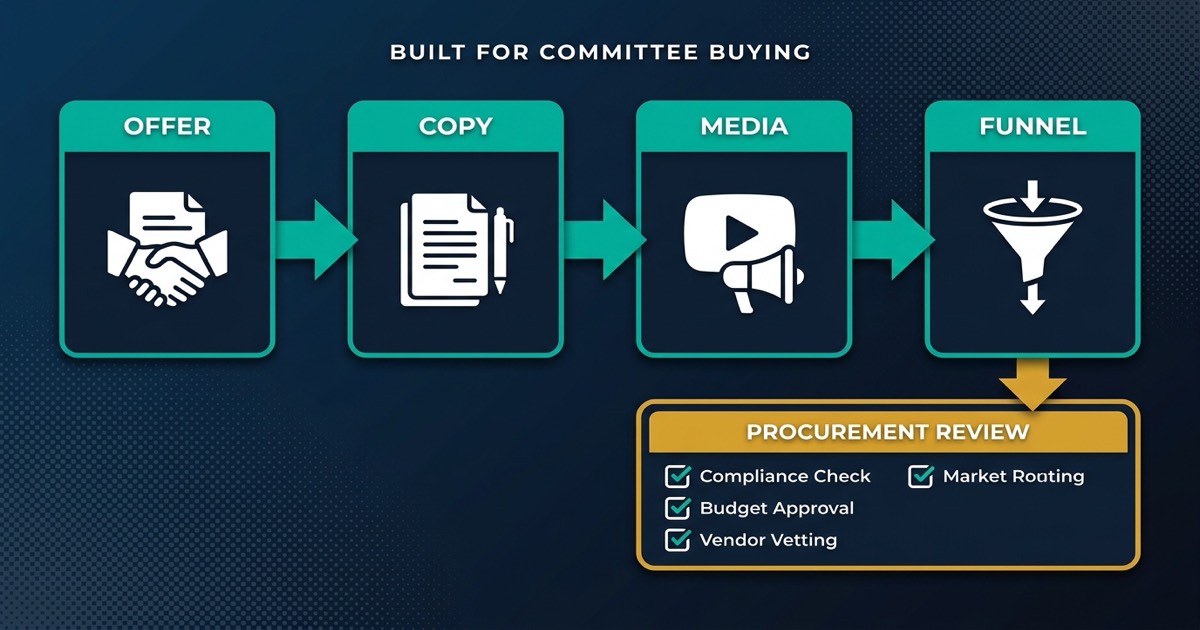
I run four layers, in order, because each one only works if the previous one is right.
The complete version is in my GCC lead generation playbook.
Layer one: the offer. This is 80% of the outcome.
In Abu Dhabi I almost never lead with "book a call." The buyer is not ready to spend a meeting on a stranger, and asking too early reads as pushy in a market that is not.
Instead the offer solves a slice of the problem up front.
An audit.
A benchmark.
A readiness assessment they can circulate internally.
That last part matters more here than anywhere.
An offer that can be forwarded to a colleague is an offer that survives a committee.
I engineer each one against the 5Ts: Type, Transformation, Trust, Time, and Ticket, which is set out in how I engineer offers.
Layer two: the copy. I write on the Triple Hook: Premise, Stakes, Twist.
The premise stops the scroll.
The stakes make the cost of inaction concrete.
The twist is the thing they did not already believe.
For Abu Dhabi, I dial the urgency down and the proof up. Specificity is the persuasion here, not pressure.
Layer three: the media. Simple structure, deep creative library.
One campaign with the budget set at campaign level. One or two broad ad sets. No stack of fifteen interest audiences.
That is because of Andromeda, Meta's delivery system, which moved targeting from audiences to creative.
Meta's own data attributes roughly 56% of campaign performance to creative quality now.
So I run 10 to 20 genuinely different creative concepts at once rather than one ad with variations.
The detail is in how I buy media.
In a market this concentrated, I also exclude existing customers and current leads aggressively.
Burning impressions on the twelve accounts you already talk to is easy to do when the total pool is small.
Layer four: the funnel. Which is where the leads become pipeline.
How lead generation in Abu Dhabi should qualify before your team spends a meeting
Qualification lives inside the funnel, not in a phone call afterwards.
Every lead is scored against BANT, which is four checks: Budget, Authority, Need, and Timing.
Can they pay, can they decide, do they have the problem, and are they ready now.
Built properly, an instant form with real qualifying questions gets me to roughly 60 to 80% qualified.
Not perfect, and I would not trust anyone who claims perfect.
The mechanics are in my BANT qualification guide.
Abu Dhabi bends one of those four letters, though.
Authority is rarely one person.
You will often speak to a manager who genuinely has the need and the budget line, but sits three approvals away from signature.
Treating that lead as unqualified is a mistake I see constantly.
They are qualified.
They are just not the whole committee.
So the job shifts from convincing them to equipping them, which is why every asset I build is designed to be forwarded upward.
And a lead who fails on Timing is not dead either.
They are early.
In an emirate where budget cycles are annual and procurement is scheduled, early is normal, and the nurture layer is what keeps them until their moment arrives.
The numbers to hold me to
Here is what good looks like across my Gulf campaigns, so you can benchmark lead generation in Abu Dhabi rather than take a promise.
- Cost per qualified lead: roughly 50 to 60 dollars.
- Cost per booked, sales-ready meeting: around 100 dollars.
- Return on ad spend: 9 to 11 times on the strongest accounts, 4 to 5 times on the weakest.
- Qualified share of inbound leads: roughly 60 to 80% through a well-built instant form.
Abu Dhabi media often costs slightly less than Dubai, simply because fewer advertisers are bidding for the same attention.
The sales cycle behind it is longer, though.
So a cheap lead here is not automatically a better lead; it is a lead that needs more patience and a follow-up system that does not give up in week three.
Judge lead generation in Abu Dhabi on cost per closed deal.
Cost per lead is the most over-watched number in the Gulf, and it is the easiest one to make look good while producing nothing.
What you get, and who this is not for
What I build and hand over: the offer, the creative library, the media structure, the qualification funnel, the CRM automation, and reporting that traces a signed deal back to the ad that started it.
You own all of it. Leads, data, accounts.
Lead generation in Abu Dhabi fits you if you sell B2B into the emirate with a deal size that justifies paid acquisition, and you can respond to a lead within a day rather than a week.
It does not fit if you want a contact list by Thursday, or if your pipeline problem is really a sales-follow-up problem wearing a marketing costume.
I would rather tell you that on the first call than take the retainer.
It also cannot fix a weak offer.
More traffic to a proposition nobody wants just gets you to the bad news faster.
If you want to see the whole machine, it is on the system page.
The core method sits on my B2B lead generation method, and the neighbouring emirate version is what I look for in a Dubai lead generation partner.
If you would rather talk it through, book a strategy call.