 Ahmed Elflal
What an email marketing agency in Dubai actually does
Most email agencies sell you sending. A monthly newsletter, a template, a report full of open rates. It looks like marketing, and it changes nothing about your pipeline.
Here is what I actually do when a Dubai B2B company hands me their email.
First, strategy and segmentation: who is on the list, how they got there, and what each segment needs to hear next. Second, the writing: sequences with a job to do, not content for the sake of content. Third, the automation build: triggers, timing, and the logic that decides who gets what. Fourth, deliverability: the technical setup that decides whether any of it reaches an inbox at all. And fifth, reporting that counts the only number I care about, which is booked sales calls.
The difference from a standalone email shop is that none of this floats on its own. Email is one layer inside the same machine I described in my method for B2B lead generation: the offer brings leads in, the funnel qualifies them, and email is what happens to everyone who is real but not ready. That last group is bigger than most people think, which is the next point.
Where email fits the B2B funnel (nurture, not capture)
Email does not capture demand. Offers and media do that. Email's job is to hold and mature the demand you already paid for.
There is a well-known finding from the Ehrenberg-Bass Institute, often called the 95:5 rule: at any given moment, only around 5% of your potential buyers are actually in-market. The other 95% will buy eventually, just not today. Most GCC campaigns are built as if the 5% is all that exists. They chase the ready buyers, discard everyone else, and wonder why the pipeline is feast or famine.
My rule is simpler: book the 5%, nurture the 95%.
When a lead comes through my funnel, they get scored against BANT: Budget, Authority, Need, Timing. The full logic is in my BANT qualification guide, but the short version is that a lead who fails on Timing is not a dead lead. They are an early lead. They have the budget, the authority, and the need; they just do not want it this quarter. Throwing that lead away is throwing away money you already spent to acquire them.
Email is where those leads live until their timing changes. Every sequence I build exists to keep the company first in mind, answer the objections that are quietly forming, and make booking a call the obvious next step the moment the lead is ready. That framing comes straight out of my GCC lead generation playbook, and it is the reason my email reports track conversations, not opens.
The core sequences I build (welcome, nurture, re-engagement)
There is no secret framework here, and I will not pretend otherwise. These are the three lifecycle sequences that email marketing has been built on for years. The edge is not in inventing new names for them; it is in building them properly and wiring them to qualification.
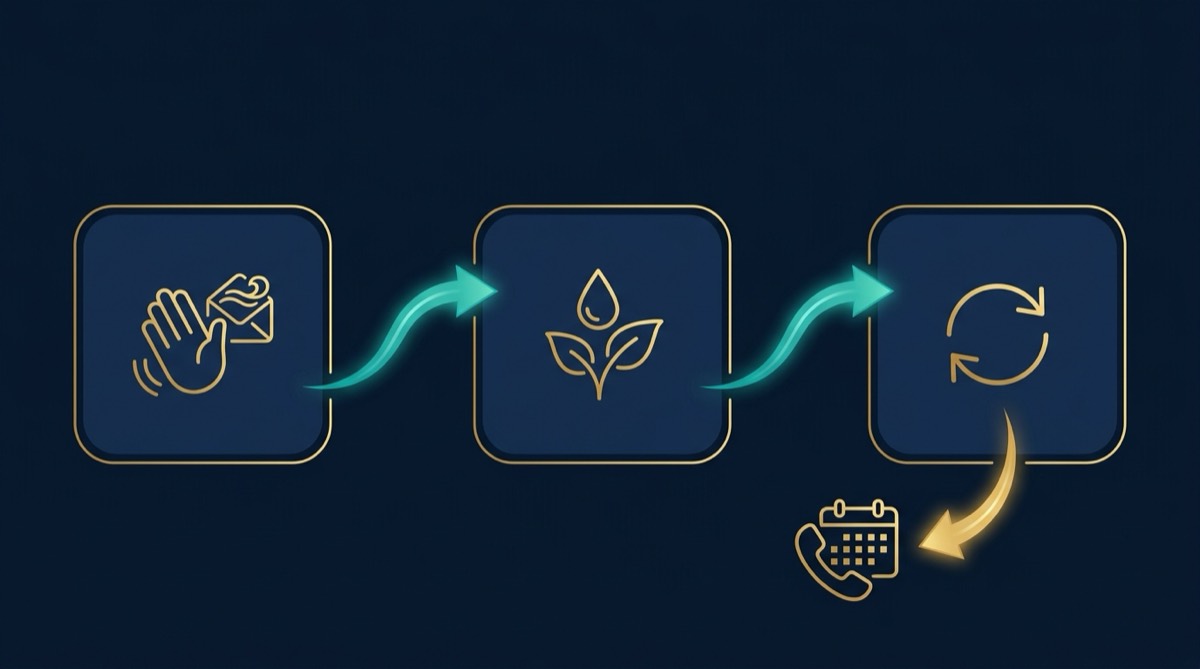
The welcome sequence. This runs over the first one to two weeks after someone opts in, while attention is at its peak. It delivers whatever they signed up for, immediately. It sets expectations: who I am, what they will get, how often. And it gives the small percentage who are already in-market a clean path to book a call right now, instead of waiting through a nurture track they do not need.
The nurture flow. This is the long game for the 95%. Roughly weekly emails that earn their place in the inbox: real answers to the questions prospects actually ask on sales calls, proof and case detail, and honest handling of the objections that stall Gulf deals. Each email maps to a gap in the lead's qualification. A lead hesitant on budget gets cost-of-inaction content. A lead who is not the final decision-maker gets material built to be forwarded upward. One idea per email, one call to action, no shouting.
The re-engagement sequence. This is the one almost nobody in Dubai builds, and it is where recovered revenue hides. Leads go quiet. It is normal. Projects get shelved, budgets freeze, people travel. At set intervals of silence, an automation wakes up and re-opens the conversation: a short, human check-in, a piece of proof they have not seen, or a direct question about whether the problem still exists. Some of the cheapest booked calls I generate come from leads everyone else would have written off months earlier. And when a lead stays unresponsive through the full sequence, they are rested rather than hammered, which protects deliverability.
Deliverability in the GCC (getting to the inbox at all)
None of the above matters if the emails land in spam. Deliverability is the unglamorous half of email marketing, and it is where most self-run email quietly dies.
The baseline is now non-negotiable. Since February 2024, Google and Yahoo require bulk senders to authenticate email with SPF, DKIM, and DMARC, offer one-click unsubscribe, and keep spam complaint rates under roughly 0.3%. Microsoft has moved the same direction with requirements for high-volume senders into Outlook. Miss these and your email does not get filtered occasionally; it stops arriving.
Then there is the GCC layer on top. B2B audiences here skew heavily toward corporate mailboxes, and UAE enterprises run overwhelmingly on Microsoft 365, which filters aggressively and forgives slowly. So I treat corporate inbox placement as its own project: a dedicated sending domain so marketing email never puts the company's main domain at risk, gradual warm-up before any real volume, and list hygiene that removes dead addresses before they poison sender reputation.
Consent matters too. The UAE's personal data protection law expects people to have actually agreed to hear from you, which is one more reason bought lists are a trap. Every address I mail raised its hand somewhere in the funnel, and that single fact does more for deliverability than any technical trick, because people do not report senders they asked to hear from.
The stack: GoHighLevel as the CRM and automation layer
Everything above runs on GoHighLevel. That is the CRM and automation layer I build on, and I use it because the whole lead generation system lives in one place: the pipeline, the lead scoring, the calendars, and the email automation, all reading from the same record.
That single-record setup is what makes the sequences intelligent rather than mechanical. A lead's pipeline stage decides which flow they are in. The answers they gave at qualification decide which emails they see. The moment a lead books a call, the nurture pauses automatically, because nothing torches trust faster than a "just checking in" email landing an hour after someone scheduled a meeting with you.
It also keeps reporting honest. Because the emails and the pipeline share one system, I can trace a booked call back to the sequence and the send that produced it. Not "email influenced revenue" hand-waving. This email, this lead, this call on the calendar. If you want to see how that machine looks end to end, the full picture is on the system page.
The results you can expect (and the ones I refuse to promise)
Let me be straight about what email does and does not do, because this is where the industry lies the most.
Email compounds; it does not explode. The first two weeks are setup and warm-up, not results. The welcome sequence starts converting the already-ready leads almost immediately. The nurture flow shows its value over one to two quarters, as leads whose timing was wrong come back on their own schedule and book. And the re-engagement sequence is usually the fastest visible win, because it mines a list you already paid for and forgot about.
What I measure is replies, booked calls, and pipeline. What I deliberately do not obsess over is open rates, because Apple's Mail Privacy Protection inflates opens to the point of uselessness. Any agency still selling you open rates as the headline metric is reporting on a number it knows is broken.
And one honest caveat: email cannot rescue a weak offer or an empty list. If the front of the funnel is broken, fixing the emails is polishing the wrong part. That is why I run this as one system, and why the same thinking shows up across the B2B marketing work I do in Dubai: every channel exists to feed one pipeline, and email is the channel that makes sure nothing you paid for leaks out the back.
If your CRM is full of leads nobody has spoken to in months, that is not a dead database. That is deferred revenue with no sequence attached. Book a strategy call and we will look at what is actually sitting in your list.