 Ahmed Elflal
Why most B2B lead generation in Saudi Arabia delivers names, not pipeline
Almost every company selling B2B lead generation in Saudi Arabia is selling you a list.
A spreadsheet of contacts.
Scraped titles and phone numbers.
Sometimes a "verified" stamp on top, which means someone confirmed the email bounces less often.
That is not pipeline. That is homework.
The gap shows up fast.
Your sales team burns three weeks calling strangers who never asked to hear from anyone.
Connect rates sit in the single digits.
Morale drops.
And the conclusion everyone draws is that Saudi B2B is just hard.
B2B lead generation in Saudi Arabia is not hard. It is mis-specified.
A lead is not a name.
A lead is a person with a real problem, a budget, and the authority to act, who raised their hand on purpose.
I have spent more than $10M in managed ad spend across the UAE, Saudi Arabia, and the wider Gulf, and sat on over a thousand recorded sales calls.
The pattern never changes: the companies that win are the ones who fix the front of the system, not the ones who buy a bigger list.
Which brings me to what actually makes Saudi different.
The Saudi reality that changes how B2B lead generation works
Most agencies run a Dubai playbook in Riyadh and wonder why it stalls. B2B lead generation in Saudi Arabia is not the Dubai system with the city name swapped.
Four things are genuinely different here.
The buyer moved to Riyadh, on purpose. Since January 2024, multinationals bidding on Saudi government contracts above roughly one million riyals have had to base their regional headquarters in the Kingdom, with a fifteen-year tax exemption as the carrot.
Hundreds of companies relocated.
That single rule reshaped the addressable market.
Your ideal client in Saudi Arabia is now frequently a regional head who arrived in the last twenty-four months, is building a supplier base from scratch, and has no incumbent loyalty at all.
That is the most winnable buyer in the Gulf right now. Most lead-gen targeting is still pointed at the old map.
The demand is real, and it is contracted. Vision 2030 is now inside its final stretch, and the giga-projects have matured from announcements into procurement.
NEOM, the Red Sea, Diriyah.
That means live demand for logistics, technology, consultancy, and industrial services, with actual budgets attached rather than press releases.
Arabic is not a nice-to-have. English-only works when you are selling to expatriate-run regional headquarters.
It quietly underperforms when you sell to Saudi-owned enterprises, family groups, and government-adjacent buyers.
I run Arabic-first creative with English variants alongside, then let the delivery data pick the winner instead of my assumptions.
The week runs Sunday to Thursday. Saudi Arabia works Sunday through Thursday, unlike the UAE, which moved its federal week to Monday through Friday back in 2022.
If your campaign calendar and your call scheduling are set to a Dubai week, you are losing two of the five days that matter.
There is one more thing that most Saudi lead-gen providers will not tell you, and it carries a real fine.
Consent is a compliance issue for lead generation in Saudi Arabia, not a courtesy
Saudi Arabia's Personal Data Protection Law requires consent before you process someone's personal data for direct marketing, and it requires a clear way to opt out.
It applies to B2B, not only consumer marketing.
The individual on the other side of a company email address is still a data subject.
And it is being enforced.
Through 2026, the Saudi Data and Artificial Intelligence Authority has issued enforcement decisions where the recurring causes include processing personal data with no valid legal basis and sending marketing communications without consent.
Read that again if you were about to buy a contact list.
A purchased database is not just low-performing in Saudi Arabia.
It is a regulatory exposure with your company's name on it, sold to you by someone who will not be there when the enforcement letter arrives.
Every lead in the system I build opted in.
That is not me being principled.
It is the only version that survives contact with the law and with a sales team.
My B2B lead generation system in Saudi Arabia, layer by layer
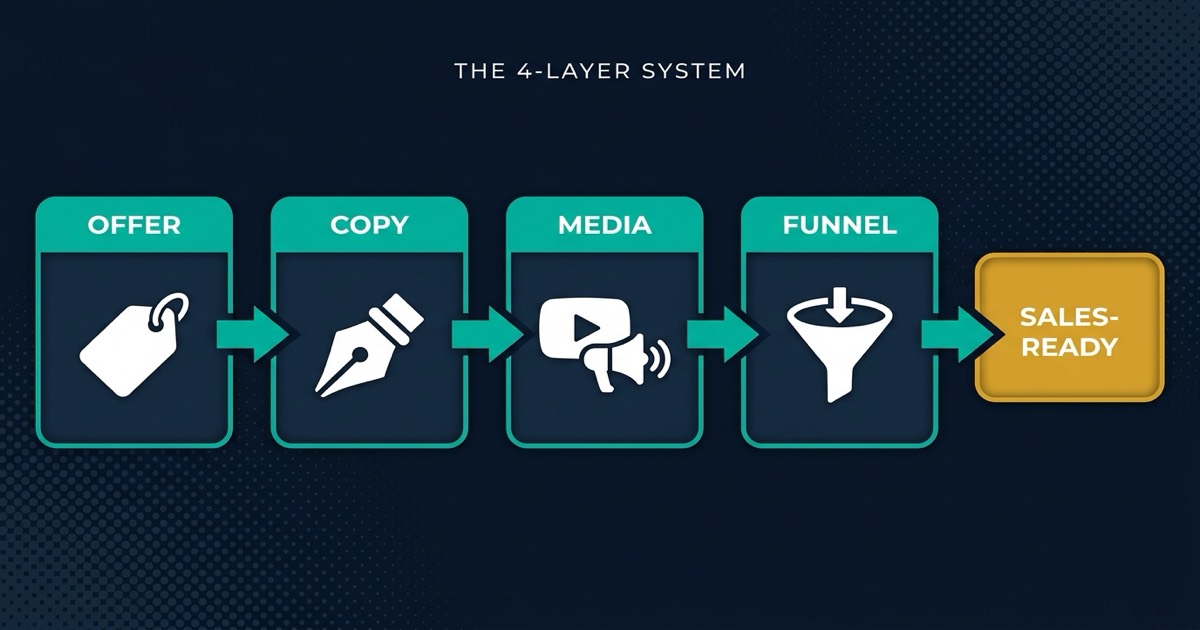
I run the same four layers for every client, and I run them in order, because each one only works if the one before it is right.
The full version lives in my GCC lead generation playbook.
Layer one: the offer. This is 80% of the result and the part everyone skips.
Nobody in Riyadh wants to "book a call" with a company they met ten seconds ago.
So I build an offer that solves a real sliver of the problem on its own: an audit, a diagnostic, a calculator, a benchmark.
I engineer it against the 5Ts: Type, Transformation, Trust, Time, and Ticket.
What kind of offer it is, what changes for the buyer, why they should believe it, how fast it works, and what it costs.
The full method is in how I engineer offers.
A good offer self-selects.
The wrong-fit buyers filter themselves out before your sales team ever sees them.
Layer two: the copy. I write ads on the Triple Hook: Premise, Stakes, Twist.
The premise is the claim that stops the scroll.
The stakes are what it costs to keep doing it the old way.
The twist is the part they did not expect, which is what earns the click.
Then the body does the work: callout, hook, problem, agitation, solution, offer, proof, urgency, call to action.
Layer three: the media. Simple structure, big creative library.
One campaign, budget set at the campaign level. One or two broad ad sets. That is it.
The reason it stays simple is Andromeda, Meta's delivery system, which shifted targeting from audiences to creative.
Meta's own data puts creative quality at roughly 56% of campaign performance now.
So the old advice of running one or two ads is dead.
I run 10 to 20 genuinely different creatives at once, and I mean different concepts, not the same ad with a new headline.
The detail is in how I buy media.
Layer four: the funnel. This is where a lead becomes pipeline, and it is the layer that separates my numbers from the industry's.
How B2B lead generation in Saudi Arabia should qualify before your sales team is involved
Qualification is not a phone call that happens after the fact. It is built into the funnel itself.
Every lead gets scored against BANT, which is four checks: Budget, Authority, Need, and Timing.
Can they pay, can they decide, do they actually have the problem, and are they ready now.
An instant form with the right qualifying questions gets me to roughly 60 to 80% qualified leads.
Not 100%, and anyone promising you 100% is selling something.
The full logic is in my BANT qualification guide.
Here is the part most people get wrong.
A lead who fails on Timing is not a dead lead. They are an early lead.
They have the budget, the authority, and the need.
They just do not want it this quarter.
Throwing that lead away is throwing away money you already spent to acquire them, which is why the nurture layer exists rather than a delete button.
Then there is the follow-up problem, which in Saudi Arabia has one obvious answer.
WhatsApp is where Saudi B2B follow-up actually happens
Email gets you filed. WhatsApp gets you answered.
Gulf B2B decision-makers run their working day from their phone, and a message thread carries a warmth that a formal email never earns in the first week.
So the follow-up sequence I build is not a drip campaign that pretends to be personal.
It is speed to lead, then a real conversation, wired into the CRM so nothing depends on someone remembering.
Every booked call is confirmed, then reminded, on the channel the buyer already uses.
That confirmation habit is what turns booked meetings into attended meetings, and it is the difference between a calendar that looks full and a calendar that is full.
The numbers you should hold me to
Here is what good looks like in my campaigns across the Gulf, so you have something to measure B2B lead generation in Saudi Arabia against.
- Cost per qualified lead: roughly 50 to 60 dollars.
- Cost per booked, sales-ready appointment: around 100 dollars.
- Return on ad spend: 9 to 11 times on the best-performing accounts, 4 to 5 times on the weakest.
- Qualified share of inbound leads: roughly 60 to 80% through a properly built instant form.
Saudi Arabia currently sits toward the expensive end of that range.
Competition for attention in Riyadh has risen sharply with the headquarters influx, and that shows up in auction prices.
But cost per lead is the most over-watched number in the Gulf.
A low cost per lead feels like winning right up until none of those leads close.
Judge B2B lead generation in Saudi Arabia on cost per closed deal. Everything else is a vanity metric with a spreadsheet around it.
What you get, and who this is not for
What I build and hand over: the offer, the creative library, the media account structure, the qualification funnel, the CRM automation, and the reporting that traces a closed deal back to the ad that started it.
You own all of it. The leads, the data, the account.
This works well if you sell B2B into Saudi Arabia with a deal size that justifies paid acquisition, and you have someone who can actually take a sales call within a day of a lead raising their hand.
It is not for you if you want a list of five thousand contacts by Thursday. That is not B2B lead generation in Saudi Arabia, it is data entry.
I do not sell those, and the companies that do are the reason you are reading this page.
It also will not rescue a weak offer.
If nobody wants what you sell at the price you sell it, more traffic just finds out faster.
If you want the whole machine in one view, it is on the system page, and the core method is on my B2B lead generation method.
If you would rather just talk about your pipeline, book a strategy call and we will look at what is actually broken.