 Ahmed Elflal
What a B2B appointment setting agency in Dubai should actually deliver
Ask ten B2B appointment setting agencies in Dubai what they sell and nine will say "qualified appointments."
Ask them what qualified means and the answers fall apart.
For some it means the person answered the phone.
For others it means they agreed to a call.
For a few it means someone at the company once downloaded something.
None of those is a qualified meeting. They are activity, repackaged as outcome.
Here is the standard I hold B2B appointment setting in Dubai to: a named decision-maker, who has the budget and the problem, on your calendar, at a time they picked, who knows exactly why the meeting exists, and who attends.
If any one of those is missing, the meeting is not qualified.
It is just an entry in a spreadsheet that makes the monthly report look healthy.
I have sat on more than a thousand recorded sales calls in this market.
The pattern is brutally consistent: companies rarely have a meeting-volume problem.
They have a meeting-quality problem that volume was hired to hide.
Where appointment setting sits, and what breaks when it moves
Appointment setting belongs after lead generation and before the sales call.
Move it in front of lead generation and you are cold-calling strangers.
Connect rates fall through the floor, your brand gets associated with interruption, and the meetings you scrape together are with people who said yes to end the conversation.
Leave it in place and the maths works.
You are booking people who already raised a hand, so the conversation is about timing and fit rather than about whether you deserve twenty minutes.
That is the real reason my show-up numbers hold up. Not clever scripting. Sequence.
So if your pipeline is empty at the top, appointment setters are the wrong hire.
Fix the lead generation system first, then add this layer on top of it.
Five questions to ask any B2B appointment setting agency in Dubai before you sign
These are the questions I would ask if I were buying this service rather than providing it.
One: what exactly makes a meeting "qualified" in your contract? Get the definition in writing, with the specific criteria.
If it is vague at signature, it will be vaguer at invoice.
Two: are your setters calling from UAE numbers registered under your own licence? This one has teeth now.
Since August 2024, UAE telemarketing has been regulated under Cabinet Resolution 56 of 2024, which requires prior TDRA approval, calls only between 9am and 6pm, screening against the Do Not Call Registry, local numbers registered to the company's commercial licence, and identifying the company and purpose at the start of the call.
Penalties start around 13,600 dollars for calling a registered number and climb toward 40,800 dollars for repeat breaches, with licence suspension available.
The regulation is written in consumer-protection terms and carries no express B2B exemption, so I treat it as binding on business calling too.
Plenty of offshore call centres sell into Dubai without meeting any of that.
The exposure attaches to your brand, not theirs.
Three: who owns the CRM and the recordings? If the answer is the agency, you are renting your own pipeline.
Four: what is your show-up rate, and how is it measured? Watch for the shell game here, which I will come back to.
Five: what happens to a no-show? If there is no recovery sequence, you are paying twice for the same prospect.
How I run B2B appointment setting in Dubai: list, script, book, confirm, show
Five steps, each one protecting the next.
The list. Small and precise beats large and hopeful.
Two hundred accounts that genuinely match the buyer beat five thousand that might.
The profile comes from FRED: Fears, Results, Expectations, Desires.
What worries this buyer, what outcome they want, what they expect from a supplier, and what they actually want underneath the stated brief.
In Dubai specifically, the buyer moves fast and switches suppliers easily, which cuts both ways.
Easier to win.
Just as easy to lose.
The script. A qualification instrument, not a pitch.
The job is to establish BANT quickly: Budget, Authority, Need, Timing.
Can they pay, can they decide, do they have the problem, are they ready now.
Done properly this gets me to roughly 60 to 80% qualified.
The mechanics are in my BANT qualification guide, and the language itself is in my appointment setting scripts.
The discipline that matters most is disqualifying out loud. A setter who never turns anyone away is not qualifying anyone.
The booking. The slot gets chosen live, on the call, on a real calendar.
Not "I will email you some options." That is where booked meetings quietly stop existing.
The confirmation and the show. The part that separates a full calendar from a full room.
The show-up number, and the shell game around it
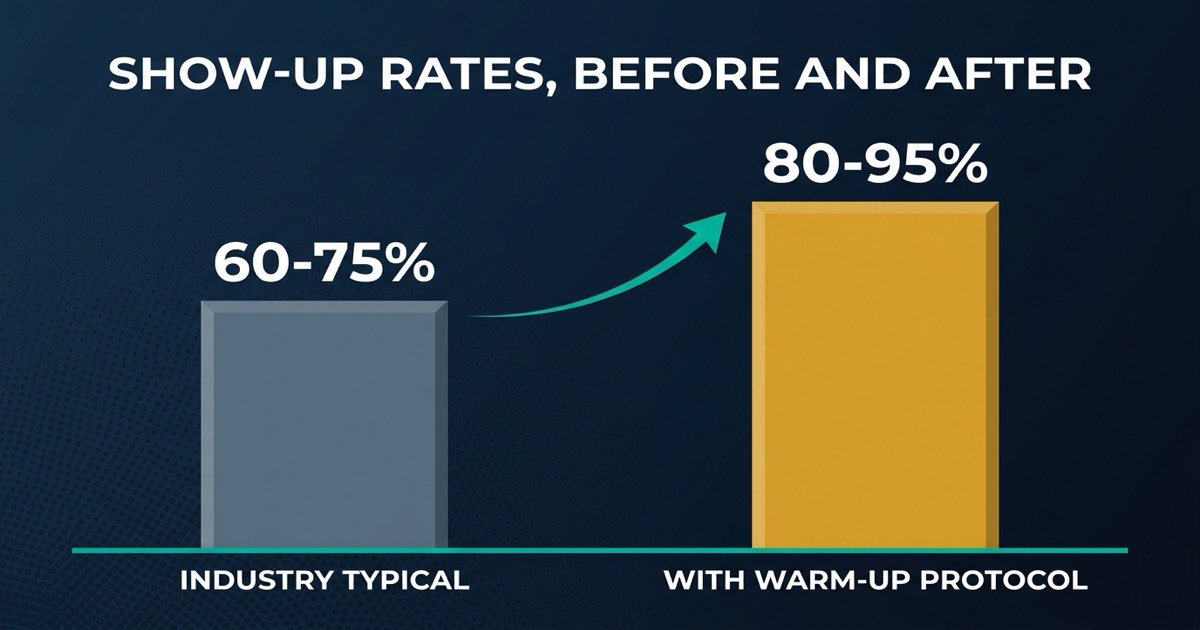
Typical B2B show-up rates sit somewhere around 60 to 75%, reaching the upper end when a provider runs double confirmation.
So on a standard setup, a quarter of what you bought does not happen.
Closing that gap takes two layers, and the order matters.
Automation gets you part of the way. Calendar holds, confirmation messages, reminders. That alone improves attendance by roughly 30 to 40%.
The rest comes from the warm-up protocol: a human touch before the meeting, on the channel the buyer actually uses, restating why this call is worth their time.
That is what takes attendance into the 80 to 95% range.
In Dubai that channel is WhatsApp.
Decision-makers here run the working day from their phone, and a thread gets read where an Outlook invite gets auto-accepted and forgotten.
Timing carries as much weight as the message.
The UAE federal working week has been Monday to Friday since 2022.
Sharjah runs a four-day week.
The private sector sets its own hours.
Prayer times reshape the usable slots inside every one of those days.
Now the shell game.
Three different numbers get quoted interchangeably in this market: show-up rate, qualification rate, and close rate.
They are not interchangeable.
80 to 95% is attendance, nothing more.
It says people turned up.
Whether they buy depends on your offer and your sales team, and an agency blending those three figures into one impressive percentage is managing your expectations, not your pipeline.
I would rather tell you that plainly than let you discover it in month three.
What you get, and the stack it runs on
Everything sits on GoHighLevel as the CRM and automation layer, with WhatsApp for follow-up and a live calendar wired into the same lead record.
One record per lead is the design rule.
Qualification answers, call notes, booking, reminders, and pipeline stage all read from one place.
That is what stops the embarrassing failures.
Nurture halts the moment a meeting is booked, so nobody gets a "just following up" message an hour after scheduling time with you.
What gets handed over: the target list, the qualification script, the booking and warm-up automation, the CRM build, the recordings, and reporting that traces each booked meeting back to its source.
All of it in an account you own.
Who B2B appointment setting in Dubai suits, and who it does not
B2B appointment setting in Dubai fits you if you sell at a deal size that justifies a human conversation, and you have someone ready to take those meetings properly.
It fits best when you already generate leads but nobody has time to work them, which is the most common shape of this problem here.
It does not fit if you want fifty meetings next month whoever is in them. That is not appointment setting in Dubai, it is calendar filling.
That is easy to deliver and worth nothing to receive.
And it cannot rescue a weak offer.
If the proposition does not survive a first conversation, more meetings just distribute the bad news faster.
For the fundamentals, start with the complete appointment setting guide or the plain-English definition.
The UAE-wide version of this service is my appointment setting in the UAE, and the outreach front end is in how I run cold outreach.
If your team is spending its week chasing meetings instead of running them, that is a system gap.
Book a strategy call and we will map where it leaks.