 Ahmed Elflal
Most B2B teams do not have a lead problem.
They have a calendar problem.
Leads come in. Someone is supposed to call them. Half never answer.
The other half book a time, then vanish on the day.
The sales rep sits on a call that nobody joins, and quietly decides the leads are bad.
They are usually not bad.
The system that was meant to carry them to the call was missing.
That system is appointment setting. Let me walk you through the whole thing, the way I build it for companies across the Gulf.
What appointment setting actually is
Appointment setting is the work of turning interest into a booked, confirmed sales call with someone who can actually buy.
That is the full definition. Interest in, a real meeting out.
It sits between two jobs people often confuse it with.
Lead generation gets a stranger to raise their hand.
Closing gets a qualified buyer to say yes.
Appointment setting is the bridge in the middle.
It takes the raised hand and carries it, qualified and warmed up, to the closer's calendar.
Skip it, and you hand your best salespeople a pile of phone numbers and hope. Hope is not a system.
Why most appointments never turn into calls
Here is what kills the standard approach.
You run an ad. Someone clicks. They drop their number on a form.
Then a rep tries to call them, cold, hours or days later.
By then the moment has passed.
A lead that felt hot the second they opted in is a half-interested stranger two days on.
The fit did not change. The moment did.
And even when they do book, nothing holds them to it.
No reminder. No reason to take it seriously. No sense of what the call is even for.
So they no-show, and everyone blames the traffic.
The real fix is to stop treating the booking as the finish line.
The booking is the start of a short, deliberate sequence that walks the prospect all the way to the call.
The B2B appointment funnel, stage by stage
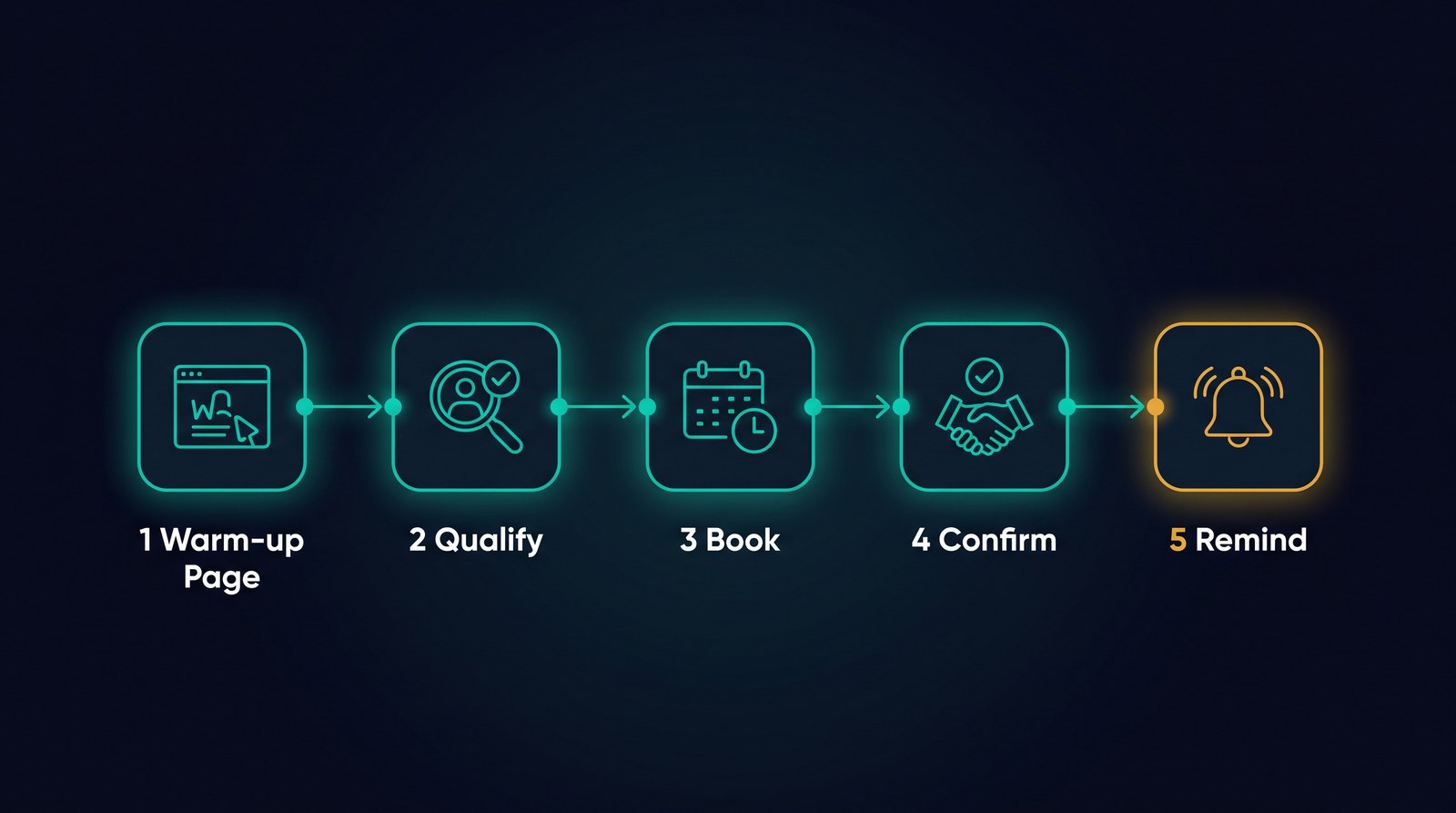
This is the machine I build. Five stages. Each one exists to remove a reason the prospect would drop off.
1. The warm-up page
Instead of sending the click to a bare form, you send it to a short page that does one job: make the prospect want the call.
It names the problem in their words.
It shows you have solved it before.
It tells them exactly what the call will give them.
By the end of the page, booking feels like the obvious next step, not a favour they are doing you.
This is where your offer does the heavy lifting. If the offer is weak, no funnel saves it. That is why I always fix the offer before I touch the funnel.
2. The qualification questions
Before they pick a time, they answer a few short questions.
Nothing heavy. Just enough to check they are a real buyer.
Budget, role, the problem they have, how soon they want it fixed.
Those four checks have an old sales name, BANT, which just stands for Budget, Authority, Need, and Timing. A real buyer is a yes on all four.
You are building the filter into the form, not the phone call.
The wrong people get sorted out here, before they ever reach a human. I go deep on this in the lead qualification guide.
3. The booking
Only now do they see a calendar.
They pick a slot that suits them. It lands in your system and on the rep's calendar at the same time.
The prospect chose the time, so the time means something to them.
4. The confirmation
The second they book, you confirm.
A message that tells them they are in, what to expect, and what to bring or think about beforehand.
This is also where you set the frame: this is a working session about their situation, not a pitch they need to brace against.
5. The reminder sequence
This is the stage almost everyone skips, and it is the one that decides your show-up rate.
Between booking and the call, a short string of reminders goes out. A message the day before. One the morning of. One an hour before, with the link.
Each one re-sells the value of showing up, in one line. None of them nag.
This single sequence is the difference between a calendar full of ghosts and a calendar full of conversations.
What a good show-up rate looks like in the Gulf
Let me give you honest numbers, because vague promises help no one.
Across the wider B2B industry, a normal show-up rate sits somewhere between 60 and 78%. That is what most programs get when they book a call and simply hope.
The funnel above pushes that to roughly 80 to 95%.
The gap is not magic. It is the warm-up page and the reminder sequence doing their job.
By the time the prospect is on the call, they already understand what they are buying. The conversation is about how to start, not whether to.
In the Gulf specifically, two things move that number further.
First, the channel. A WhatsApp reminder gets opened in minutes. An email reminder often does not. So the confirmation and reminders run where the prospect actually is.
Second, speed. Whenever a slot is missed or a lead stalls, you reach out fast, while it is still warm. Minutes, not days.
When to use appointment setting, and when not to
Appointment setting is not the right tool for every offer.
There are two delivery systems, and the price of what you sell decides which one you use.
For lower-priced, higher-volume offers, a quick instant form often beats a full appointment funnel. An instant form is the short form that opens right inside Facebook or Instagram, so the person never leaves the app. It runs cheap and fast and holds quality around 60 to 80%.
For high-ticket offers, where one deal is worth real money, you want the appointment funnel. Fewer leads, far higher quality, and a booked call with someone who is ready to talk seriously. This is the path that reaches 90 to 95% qualified.
Small and frequent goes to the instant form.
Big and considered goes to the appointment funnel.
If you sell a 50,000 dollar engagement, you do not want a thousand cheap form fills. You want twelve booked calls with people who can sign.
What to actually say in your confirmations and reminders
People treat reminders as admin. "Your call is at 3pm." That is a wasted message.
Every reminder is a tiny chance to re-sell the call. So each one carries one line of value, not just a time.
The confirmation, right after they book, does three things. It tells them they are in. It tells them what the call will cover, in their words. And it sets the frame: this is a working session about their situation, not a pitch they need to defend against.
The day-before reminder adds a reason to keep the slot. One sentence on what they will walk away with.
The morning-of reminder is short and warm, and asks for a simple reply to confirm. A reply is a small commitment, and small commitments hold.
The one-hour reminder is just the link and a friendly nudge. Make joining frictionless.
None of these nag. Each one earns the next minute of their attention. That is the whole craft.
Manual setting or an automated funnel: which you need
There are two ways to set appointments, and they are not rivals.
The automated funnel is the machine above: a page, a form, a calendar, and a reminder sequence that runs without a human in the loop. It scales, it is consistent, and it is cheap per booking. Most Gulf B2B offers should start here.
Manual setting is a person, often called an SDR or appointment setter, reaching out by message or call to book the meeting by hand. It is slower and more expensive per booking, but it shines for large, complex deals where a human touch and real conversation move the prospect.
The strongest setups use both. The funnel handles volume and books the obvious-fit prospects automatically. A person steps in for the high-value leads that deserve a hand on the shoulder. In this region, a lot of that manual setting happens inside the chat itself, on WhatsApp or Messenger, where the buyer already is.
The numbers that tell you the system is working
Watch four numbers, and you will always know which part to fix.
Contact-to-meeting rate: of the people who enter the funnel, how many book. Across B2B this usually sits between 4 and 10%. If yours is far lower, the warm-up page or the offer is weak.
Show-up rate: of those who book, how many actually attend. Industry norm is 60 to 78%. The funnel here targets 80 to 95%. If yours is low, the reminder sequence is thin or running on the wrong channel.
Qualification rate: of those who show, how many are a genuine fit your closer would want. If this is low, your form is letting the wrong people through.
Cost per booked meeting: what you pay for one held appointment. Blended mid-market B2B often lands around 180 to 280 dollars through cold outbound. A tuned paid funnel in the Gulf can sit well under that, which is the whole point of building it as a system.
One leaking number points at one broken stage. That is why you measure them separately.
The mistakes that quietly wreck appointment setting
Booking with no reminders. The single biggest leak. A calendar full of bookings and no sequence is a calendar full of ghosts.
Sending raw traffic to a bare calendar. With no warm-up page, only the tiny ready-now slice books, and even they show up cold.
Asking too much on the form. Ten questions before they can book kills the booking rate. Ask the few that matter, save the rest for the call.
Treating the call as the goal. The booked call is a milestone, not the win. The win is a closed deal, so the follow-up after a no-show or a maybe matters as much as the booking itself.
Slow follow-up. We will come back to this, because it undoes everything upstream.
How appointment setting fits the rest of the machine
One funnel does not run on its own.
It sits inside a longer chain: traffic, then capture, then qualification, then the booking, then follow-up, then the call, then reporting, then doing it again better.
Appointment setting owns the middle of that chain. But it only works if the parts before it are sound.
If the offer is weak, people will not book.
If the media buying brings the wrong audience, the qualified ones will be rare.
If nobody follows up fast, even booked calls go cold.
So treat appointment setting as one part of one machine, with one owner who watches the whole thing end to end. That single-owner idea is the heart of how I run the whole campaign.
Get the chain right, and the calendar stops being a problem.
It starts being the most predictable part of your week.